System architecture
The blueprint of your IBM i: subsystems, partitions, environments, and how they relate to the business functions they carry.
Architecture diagram set, editable source included

The people who built your AS400 estate are retiring.
We help you document what they know before they go
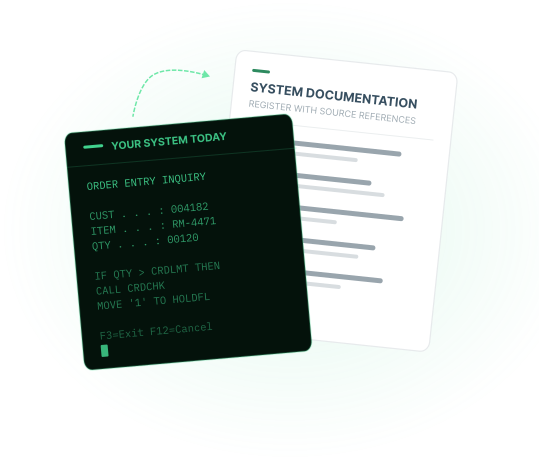
IBM supports IBM i until 2035, so the system is not going anywhere. The people who know how it works are a different story. Most shops expect to lose them around 2030, which leaves about five years running a system nobody remembers building.
Now until about 2030
The people who built and maintained your system are still on the payroll. This is the only window in which you can ask them anything.
About 2030 to 2035
The system still runs and IBM still supports it. But when something breaks or needs changing, nobody left in the building knows why it was built that way.
The blueprint of your IBM i: subsystems, partitions, environments, and how they relate to the business functions they carry.
Architecture diagram set, editable source included

What the system does, department by department, so a non-RPG reader can navigate it without a translator.
Functional map and narrative overview

Every library, object, and program in scope, split into what is live, what is dormant, and what is dead.
Searchable inventory in Excel and Confluence

The operational framework around the system: standards, controls, and the procedures your auditors will ask for.
Policy pack aligned to your audit scope
Align your future efforts depending on the current level of AS400 documentation
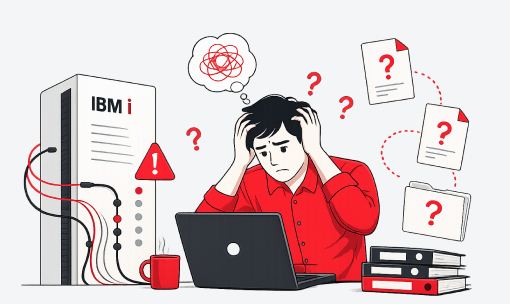
Lack of proper documentation for IBMi systems can create chaos for businesses. Without it, planning system upgrades and training new team members can turn into a nightmare. Ensure smooth operations and seamless transitions with thorough IBMi system documentation.

At this point, various users and tech members lack a full understanding of the system's functionality. It's crucial for companies to invest in some effort in consistently documenting their systems across all programs.

Businesses that prioritize documentation best practices make sure their systems are well-documented across multiple levels, ensuring clarity and accessibility for all users.
A four-stage AS400 documentation engagement designed to give you visibility early. Each stage has a clear timeframe and a defined deliverable, so you start seeing useful output within weeks, not months.
We start by understanding the shape of your IBM i estate: program volumes, libraries, source availability, documentation gaps, and what your team actually needs documented.
We run automated analysis across a representative portion of the estate to understand its size and complexity. This helps identify highly interconnected programs, unused or redundant code, and areas likely to require deeper documentation.
Your AS400 documentation is delivered in fortnightly increments rather than held until the end of the engagement.
Your team reviews each release as the work progresses, giving us the opportunity to validate business logic, correct assumptions, and refine the documentation while the relevant code is still being analyzed.
Once complete, the documentation is delivered into the system your team already uses, whether that is Confluence, SharePoint, Git, or another agreed repository.
From there, we can maintain the documentation as the application changes under an ongoing engagement or complete the handover so your internal team can manage it independently.
AI helps us analyze large IBM i estates faster, generate first-draft documentation at scale, and give engineers a stronger starting point for validation.
AI reads RPG, CL, and COBOL source and turns complex program logic into clear, plain-English summaries.
AI analyses large volumes of source code in parallel, making it practical to document more of the AS400 estate at once.
AI identifies calculations, conditions, thresholds, exceptions, and other business rules embedded in the code.
AI traces how files and fields are used and helps translate technical names into meaningful business descriptions.
AI helps locate where calculations happen, which programs update a file, and what depends on a specific program.
AI applies a consistent structure and level of detail across program summaries, business rules, dependencies, and data definitions.
Trusted by product teams and enterprises running on IBM i.
Here's how we helped teams document critical IBM i knowledge, prepare for compliance requirements, and plan modernization with a clearer view of their systems.
We combine deep IBM i expertise, dedicated delivery capacity, and AI-assisted analysis to document systems faster without removing engineering oversight.





Years of working with IBM i environments help us spot the logic, dependencies, workarounds, and edge cases that source code alone does not always explain.

We can analyze and document multiple parts of the estate in parallel, keeping delivery moving without depending on one or two overstretched resources.

The engineers validating your documentation understand legacy IBM i patterns, so unusual logic is investigated in context rather than misread or oversimplified.

AI accelerates code analysis and first-draft documentation. Experienced engineers review and validate every artefact before it reaches your team.
Your IBM i environment rarely needs just one kind of support. Beyond documentation, we help with modernization, automation, cloud, data, integration, and ongoing AS400 operations.
Read our latest publications to stay ahead of cut-throat competition
When it comes to AS400, experience is not optional. It is the one thing that cannot take a back seat, especially when you are choosing a service provider to work with.
Read More >
It's easy to think of AS400 support as a routine. A few password resets, some user updates, maybe a system check here and there.
Read More >
IBM has officially announced that standard support for IBM i 7.4 will end on September 30, 2026. After this date, organizations running IBM i 7.4 will only be eligible for Service Extension support.
Read More >
Learn how enterprises bridge legacy IBM i systems with modern applications, APIs, and cloud platforms for seamless operations.
Read More >
Automated the AS400-based invoicing process, eliminating manual data entry and significantly improving processing speed.
Read More >
Built payment processing integrations on iSeries for a fitness club solution provider, enabling secure transaction handling.
Read More >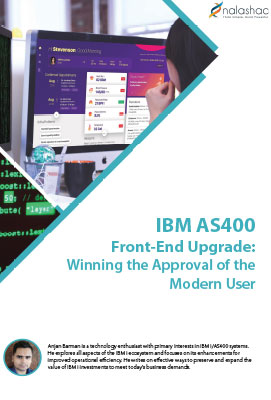
Learn how front-end enhancements to AS400 systems can improve user experience, increase adoption, and modernize legacy interfaces.
Read More >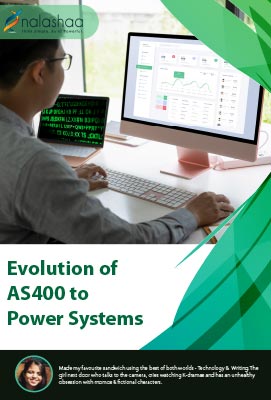
Trace the evolution of IBM's AS400 platform through its transformation into Power Systems and what it means for enterprises today.
Read More >A practical guide to connecting AS400 with modern enterprise platforms, APIs, and cloud services without disrupting core operations.
Read More >