Store-Compliant App Maintenance

Mobile App Maintenance and Support Services

Nobody thinks about app maintenance until the store stops accepting builds or the reviews turn. We keep iOS and Android apps compliant, stable, and shipping, so the app you paid to build keeps earning.

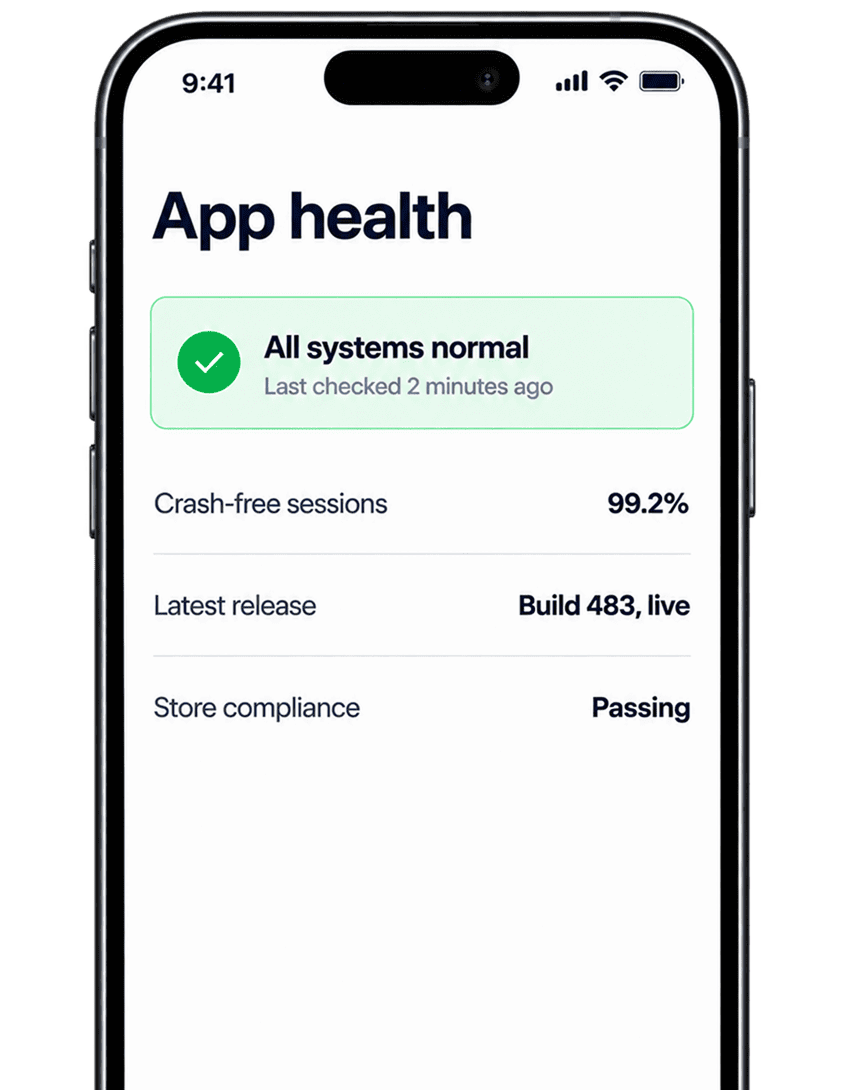
Mobile app health dashboard showing all systems normal, 99.2% crash-free sessions, and passing store compliance

2026 Store Requirements

Is your app still allowed on the stores?

Both app stores raised their minimum requirements in 2026. Falling behind does not remove your app from anyone's phone, but it does stop you publishing updates.

Deadline August 31, 2026

Google Play

  • New apps and app updates must target Android 16, API level 36 or higher to be submitted
  • Existing apps must target Android 15, API level 35 or higher to remain available to new users on devices running a newer Android version than the app targets
  • Apps targeting Android 14, API level 34 or lower stay available only on devices running the same or an older Android version
  • An extension to November 1, 2026 can be requested through Play Console
  • Form-factor floors differ: Wear OS and Android XR at API 34, Android TV at API 33, Android Automotive at API 32

In force since April 28, 2026

Apple App Store

  • Uploads to App Store Connect must be built with Xcode 26 or later, using the iOS 26, iPadOS 26, tvOS 26, visionOS 26 or watchOS 26 SDK
  • Builds on an older SDK are rejected at upload with error ITMS-90725
  • Updated age-rating responses were required by January 31, 2026 to avoid submission interruptions

Your Android target sits in build.gradle as targetSdkVersion. Your iOS build toolchain version is in Xcode under build settings. Send us both and we will come back with what it takes to close the gap.

Check My App's Compliance

Self-Check

Four things that mean your app is drifting

Apps rarely fail all at once. They drift, and the early signs show up where the product team is not usually looking.

01

Nobody owns the release button

The agency that built it moved on, the developer who knew the codebase left, and the last submission was handled by someone guessing. Store credentials and signing keys are somewhere in an old email thread.

02

Ratings are sliding and you cannot say why

Reviews mention problems on devices nobody on the team owns. The crash tool is either not installed or nobody has opened it in months.

03

Every OS release becomes a fire drill

A new iOS or Android version lands and something breaks: login, camera, notifications, a payment flow. The team finds out from users rather than from testing.

04

The app has not shipped in months

Not because there is nothing to ship, but because a dependency is stuck, a build is failing, or the last attempt stalled and nobody had time to see it through.

Any one of these is manageable on its own. Together they usually mean the app is one OS update away from a real problem.

Mobile App Maintenance and Support Services

Our mobile app support and maintenance services cover the ongoing engineering work that keeps a published app functional, secure, and publishable.

  • Target platform version upgrades planned ahead of store cutoffs
  • Submission handling and binary preparation
  • Rejection triage, appeal, and resubmission
  • Staged rollouts and rollback readiness
  • Crash and ANR triage against real session data
  • Reproduce on the affected device and OS combination
  • Root-cause fix with regression coverage
  • Hotfix path for production-critical breaks
  • Beta-cycle testing against upcoming iOS and Android releases
  • Fragmentation testing across the device and screen matrix that matters to your users
  • Deprecated API replacement before removal
  • Permission and background-behavior changes handled before flows break
  • Version upgrades and replacement of abandoned libraries
  • Vulnerability scanning across the dependency tree
  • Push notification certificate renewal before expiry
  • Authentication, payment, and analytics SDK maintenance
  • Mobile-specific threat review covering storage, transport, and runtime
  • Keychain and keystore handling, certificate pinning
  • Privacy manifest and data-safety declaration upkeep
  • Remediation tracked to closure, not just reported
  • Cold-start and screen-render profiling
  • Download and install size reduction
  • Memory and battery drain investigation
  • Network payload and caching optimization
  • Small to mid-size features and UI updates
  • Alignment with current platform design conventions
  • Store listing, screenshots, and description upkeep
  • Review responses and rating recovery

Why teams hand us their apps

15+

Years in product engineering

100+

Applications supported across web and mobile

ISO

9001:2015 Quality and 27001:2022 Security, Intertek-certified

US HQ

Edison, New Jersey, with engineering teams in Bangalore and Kochi

Proven results

What changes once releases, crashes, and upkeep are somebody's job

Measured across the apps we maintain under an agreed service level.

99%

Crash-free session rate on supported apps

95%

Releases accepted on first submission

40%

Reduction in open defect backlog within the first quarter

3 days

Average time from critical report to production fix, in business days

Your app is running right now. Is anyone watching it?

A short call with the engineers who would do the work, not a discovery call with a salesperson.

Talk to Our Mobile App Team
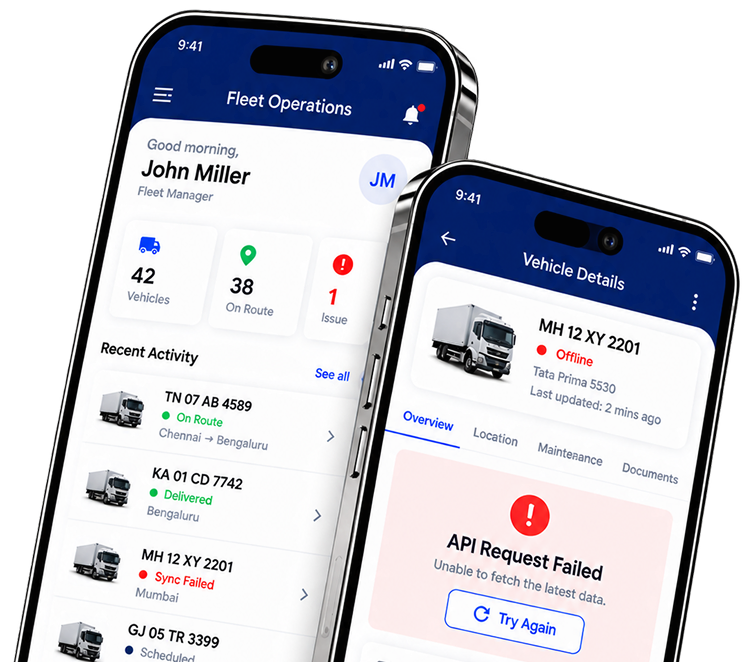
Fleet operations app screens showing a sync failure and a failed API request

Mobile app maintenance cost and support plans

Mobile app maintenance services are normally billed as a monthly retainer sized to the engineering hours and response speed you need. Plans below run from shared-resource support to a fully dedicated team.

Red

Shared

$500/month

5 hours per month

A stable app that needs a watchful eye and occasional fixes

Orange

Shared

$725/month

10 hours per month

Small apps with light monthly upkeep

Yellow

Shared

$1,200/month

20 hours per month

Regular patching and quarterly releases

Green

Shared

$2,000/month

40 hours per month

Active apps with a steady defect and enhancement flow

Blue

Shared

$3,200/month

80 hours per month

Multi-platform apps on a monthly release cycle

Indigo

Dedicated

$4,800/month

160 hours per month

A named team owning the app end to end

Violet

Dedicated team

Let's talk

Scoped to the programme

Multi-app portfolios and program-scale work

Scope my portfolio →

Every plan carries the same response commitments unless your agreement tightens them.

What moves the number

  • Platform count. One shared codebase or two native ones is the single biggest factor
  • Release frequency. Monthly releases cost more to support than quarterly ones
  • Dependency debt. An app several SDK generations behind needs catch-up work before steady state
  • Regulatory scope. Apps handling health, payment, or child data carry additional review overhead
  • Response speed. The tighter the response commitment in your agreement, the higher the retainer

What sits outside a maintenance plan

Ground-up rewrites, new platform launches, and major feature builds are scoped separately. We will tell you when something you have asked for is a project rather than maintenance, rather than quietly consuming your retainer with it.

How we work

Taking over an app, then keeping it running

Mobile application maintenance & support services usually begin with an app somebody else built. We treat that as a process to run, not a risk to absorb.

Takeover

01

Access and inventory

Repository, store accounts, signing certificates, and third-party service credentials collected and verified.

02

Codebase assessment

Architecture, dependency tree, dead code, and security exposure mapped.

03

Documentation rebuild

A working baseline reconstructed from the running system rather than from what was originally promised.

04

Stabilize

Compliance gaps, crashes, and security issues cleared in that order.

05

First release under our watch

A clean, tested build ships before ongoing maintenance begins.

You keep the code, the store accounts, and the credentials throughout. Everything we document belongs to you whether or not you stay with us.

Steady state

  • Fixed release cadence agreed up front, not negotiated ticket by ticket
  • Continuous monitoring with alerting, so issues reach us before they reach you
  • A named engineer and a named escalation path, not a shared inbox
  • Monthly report covering what broke, what shipped, and what is coming

Engagement models

  • Dedicated team. A named team owning continuous maintenance and enhancement.
  • SLA-based support. Tiered response times for incidents and requests.
  • Time and materials. Flexible hours for variable or one-off work.
  • Fixed scope. Defined deliverables at an agreed price.

Response commitments

Severity What it means First response Target resolution
P1 App down, launch failure, payment or authentication broken Within 1 business day 2 to 3 business days for a fix or workaround
P2 Major feature broken with no workaround Within 1 business day 5 business days
P3 Feature degraded, workaround available Within 2 business days Next scheduled release
P4 Cosmetic issue, minor defect, or enhancement request Within 3 business days Scheduled by agreement

App maintenance services across the industries we serve

Different sectors break in different places. We maintain to the standard yours is held to, not a generic checklist.

Industry Compliance Where these apps break
Healthcare & HIT HIPAA, HITECH Data at rest on the device, session timeout behavior, audit trails across app updates
Financial Services & FinTech SOC 2, PCI-DSS Certificate pinning, biometric authentication changes between OS versions, transaction retry logic
Retail & eCommerce PCI-DSS Checkout abandonment from slow cold starts, in-app purchase receipt validation, peak-load handling
Education & EdTech FERPA, COPPA Age-rating declarations, offline content sync, entitlement logic on subscription renewal
Fitness & Wellness GDPR, CCPA Background activity tracking, wearable pairing after OS updates, health-data permission changes
Logistics & Field Services Background location behavior, offline queue integrity, battery drain on all-day devices
Manufacturing & Industrial Barcode and scanner integration, rugged device support, ERP-connected data sync
SaaS & ISVs SOC 2, GDPR White-label build pipelines, API version drift between client and server, multi-tenant authentication

The toolchain behind your app

What we run so problems surface before your users find them.

Crash and performance monitoring

  • Firebase Crashlytics
  • Sentry
  • New Relic Mobile
  • Instabug

Build and release automation

  • Xcode
  • Android Studio
  • Fastlane
  • Bitrise
  • GitHub Actions

Store operations

  • App Store Connect
  • Google Play Console
  • TestFlight
  • Firebase App Distribution

Security and code quality

  • MobSF
  • Snyk
  • SonarQube
  • OWASP MASVS

Your app

Send us your store link and we will run a free health check.

No commitment. You get back what we would fix first and why.

Get a Free App Health Check

Work with us

Your mobile app maintenance plan starts with one conversation

Tell us the app, the platforms it runs on, and what prompted the search for mobile app maintenance services. A mobile engineer reviews every submission before anyone replies.

  • Include your App Store or Play Store link
  • Include your current target SDK, if you know it
  • Tell us which platforms the app runs on
Field will not be visible to web visitor

Frequently asked questions

They are the work of keeping an app alive after launch, as opposed to building it. An app sits on platforms that change underneath it, so maintenance is the discipline of absorbing that change before it reaches your users, usually under an agreed service level rather than ad hoc.
Two things that vendors often blur together. Support is reactive, answering incidents, tickets, and user-reported problems as they arrive. Maintenance is proactive and scheduled, done whether or not anything has gone wrong. Most agreements include both, so check how each is priced and staffed before comparing quotes.
Ask three things. Whether they will commit to response times in the contract rather than in the pitch, whether they have worked on code they did not write, and what happens to your credentials and documentation if you leave. Vague answers to any of the three are the answer.
At minimum once a year, to stay within store target requirements. In practice quarterly is the floor for a commercially active app, because security patches and platform previews arrive faster than an annual cycle can absorb.
Yes, and it is the most common way apps reach us. What we need up front is repository access, store account access, and whoever remembers the most about it for an hour. Missing documentation slows the start but does not prevent it, since we rebuild the baseline from the running app.
The commercial damage arrives quietly. Existing users keep the app and notice nothing, so the problem often goes unreported while new installs on current devices fall away. Recovery means an SDK upgrade and a full regression pass, which takes longer the further behind you are.
A contract defining what is covered, how quickly issues are answered by severity, how many engineering hours are included, and what falls outside scope. The severity definitions matter more than the hour count, because they determine what happens on your worst day rather than your average one.
Yes, native and cross-platform. Worth knowing when comparing quotes: two separate native codebases carry close to double the compatibility and release work of one shared codebase, so a quote that treats them the same is either padded on one side or thin on the other.
In-house works when releases are frequent enough to keep a mobile engineer occupied. Below roughly one release a month, a retainer usually costs less and covers more ground, because maintenance demands iOS, Android, security, and release-engineering skills that rarely sit in one person.
There is no reliable universal percentage, and the ones quoted online tend to come from agencies rather than from data. Budget from the work instead: platform count, release cadence, and how current the dependencies are. We size a plan after looking at the app.