Next-Gen AI-Powered
AS400 Integration Services
We help you connect AS400 with ERP, CRM, cloud platforms, web apps, APIs, and data platforms for smoother operations.
Explore Our ExpertiseLeave your query there, our experts will reach back at your convenience
 Schedule Your Integration Call
Tools and Platforms You Can Integrate with AS400
Here are some of the key tools and platforms our AS400 integration experts can connect with your AS400 environment to support your business operations.
 Dynamics 365
 Salesforce
 SAP S/4HANA
 NetSuite
 HubSpot
 IBM DB2
 SQL Server
 Oracle
 PostgreSQL
 Snowflake
 Power BI
 Tableau
 Looker
 QlikView
 Domo
Domo Mailchimp
 Marketo
 SF Marketing Cloud
 HubSpot Marketing
 Campaign Monitor
 Azure
Azure AWS
AWS GCP
GCP Azure Blob
 Amazon S3
 Magento
 Shopify
 BigCommerce
 Stripe
 Square
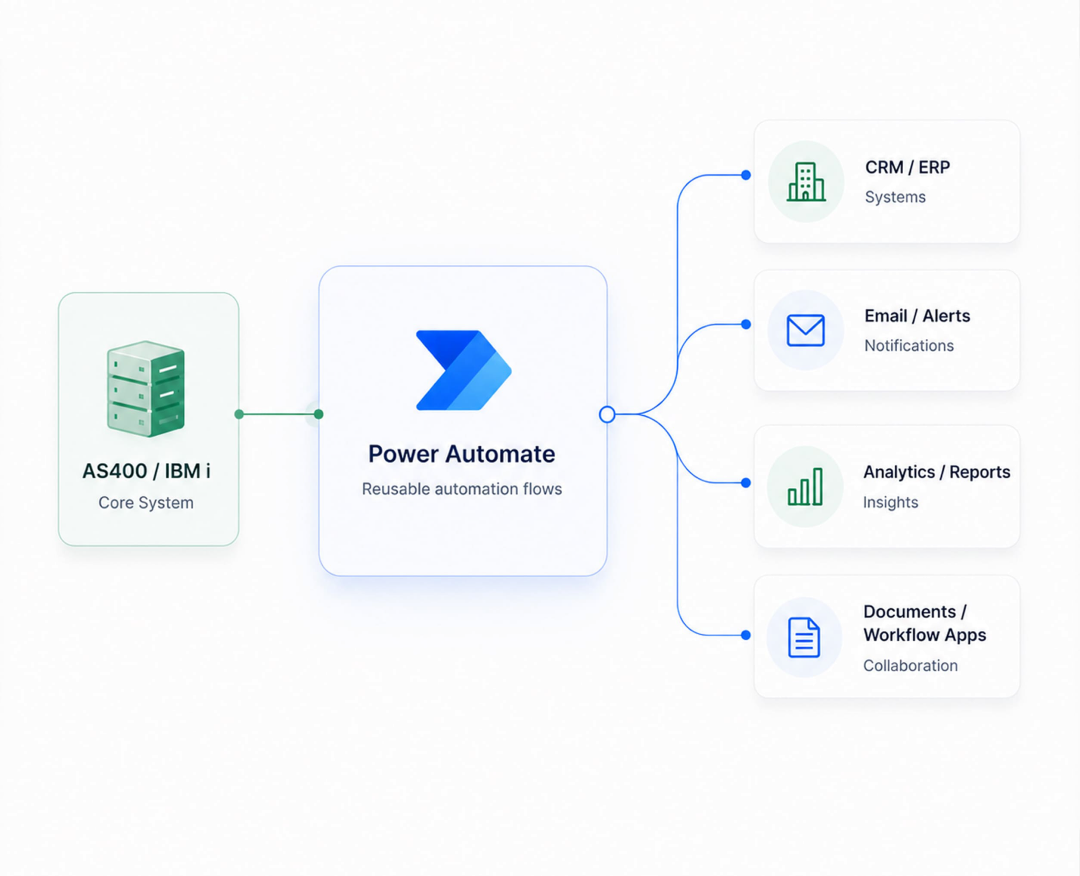
 Power Automate
 UiPath
 IBM watsonx
 Azure AI
 OpenAI
 Excel
Excel Google Sheets
 Jira
Jira GitHub
 Trello
 JD Edwards
 Infor
Infor BPCS
BPCS MAPICS
Looking to connect AS400 with any of the platforms above, or do you have a different system in mind?
Get Expert Help
AS400 Integration Approaches That Fit Modern Business Needs
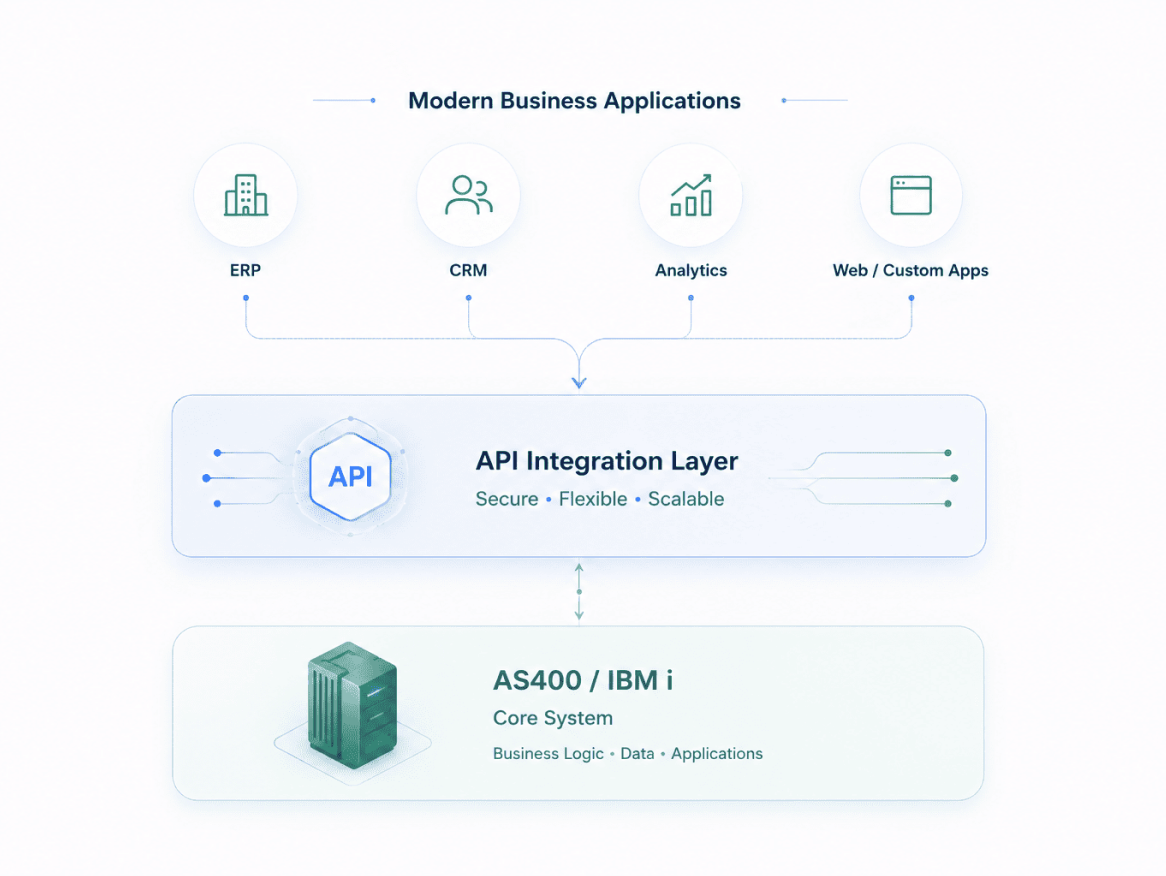
AS400 integration today is not just about connecting systems. It is about ensuring continuity, enabling real-time data access, and supporting evolving business demands without disrupting what already works.
API-Driven Integration
APIs provide a flexible way to connect AS400 with modern applications, databases, and platforms. This approach works well when integrations need to be tailored to specific business processes and data flows.
- Enables direct communication between AS400 and external systems
- Supports custom workflows and business logic
- Offers better control over how data is exchanged
- Suitable for complex or highly specific integration scenarios
Connector-Based Integration
Pre-built connectors simplify integration by reducing the need for extensive custom development. These are useful when speed, scalability, and repeatability are important.
- Faster setup compared to custom-built integrations
- Reduces dependency on heavy coding efforts
- Handles large volumes of data efficiently
- Allows reuse of integration logic across multiple systems
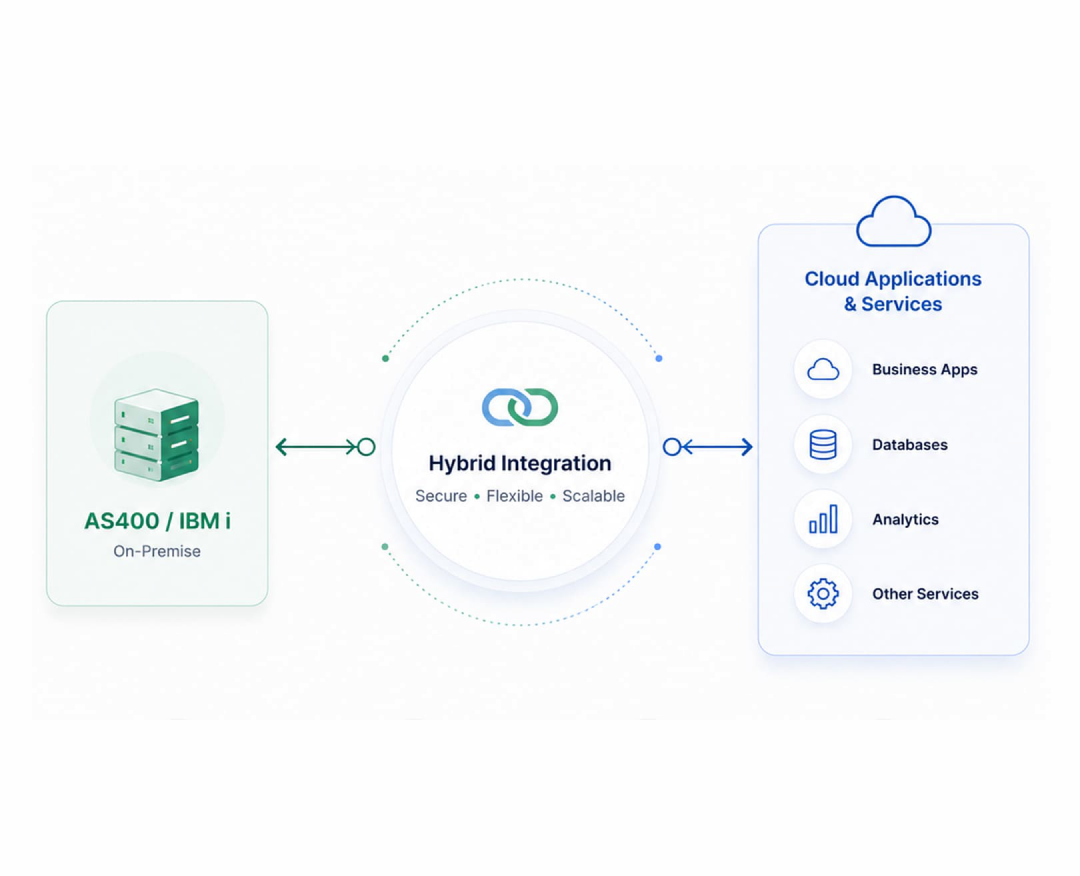
Hybrid Integration
Hybrid integration combines on-premise AS400 environments with cloud platforms, allowing businesses to modernize without fully replacing legacy systems.
- Keeps critical workloads stable on existing infrastructure
- Connects AS400 with cloud applications and services
- Supports real-time or near real-time data exchange
- Provides a balanced path between stability and modernization
Tools of Trade





Nalashaa's Interface Development Plan
Dedicated Resource
- Priorities dictated by you
- Can be leveraged across implementations
- Acts as your own team
Per Interface
- For unpredictable volumes
- Design & document interfaces
- Nalashaa requires lead time
We Use AI to Make Our IBM i Integration Services Smarter
AI is transforming IBM i (AS/400) integration by simplifying connections with modern platforms like Dynamics 365, Salesforce, cloud services, analytics tools, and automation solutions.
AI can help surface business logic hidden inside RPG and COBOL programs, making it easier to expose legacy functions as APIs. This creates a more practical path for connecting AS400 with modern applications without forcing a full rewrite.
One of the biggest challenges in AS400 integration is translating DB2-based data structures into formats that modern applications can understand. AI can support this by identifying relationships, suggesting mappings, and improving the way data is prepared for CRM, ERP, reporting, and cloud integrations.
AI can support code understanding, refactoring, and modernization of legacy programs so they are easier to connect with external platforms. This is especially useful when AS400 systems need to interact with web applications, APIs, analytics environments, or workflow tools.
In many organizations, integration still depends on repetitive manual work around terminal-based processes. AI, when combined with RPA, can help automate these flows, reduce rekeying, and create a more reliable bridge between AS400 and downstream systems.
AI can strengthen how AS400 works with platforms such as Dynamics 365, Salesforce, Snowflake, Power BI, ServiceNow, and cloud-based applications by improving orchestration, reducing manual effort, and supporting real-time or near real-time interactions.
Nalashaa Testimonials
Nalashaa helped us accelerate our software releases. Their insights into how commercial-grade software is built have been valuable.

Nalashaa's strong experience in Dynamics product-line helped bring the power of Jitterbit integration platform to the Dynamics family of products.

Our partner in business strategy not only because of the domain knowledge but also because of the flexibility.

Nalashaa did a great job in understanding our needs and handling the project from both a technical and project management perspective.

We partnered with Nalashaa for our first RPA project and were truly impressed by their professionalism, responsiveness, and dedication. Despite the time difference, their core team stayed aligned with our hours.

Nalashaa's team is an invaluable partner to us; they understood our challenges, questioned ideas, and refined features as product owners. Their approach gave us a smoother system, better coordination, and reliable support.

Need help connecting IBM i with modern enterprise platforms?
Talk to Our IBM i Integration Experts
Why Choose Us
Why Choose Nalashaa for AS400/IBM i Integration Services?
Business-First Integration Thinking
AS400 integration is planned around business goals, operational bottlenecks, and future scalability, not just technical connectivity. The focus stays on helping systems work better for the business, not forcing generic integration decisions.
Deep IBM i and AS400 Experience
As an experienced IBM i integration company, we bring expertise across IBM i environments, legacy applications, and enterprise integrations. This makes it easier to connect stable legacy systems with modern platforms without losing sight of performance, reliability, or business continuity.
Agile and Transparent Delivery
An agile integration approach keeps projects moving with better visibility, steady progress, and room for collaboration. Cross-functional expertise can be brought in where needed, while timelines, priorities, and execution stay clear throughout the engagement.
Support That Extends Beyond Delivery
Integration success is not limited to go-live. Ongoing technical support, active issue resolution, and continuous improvement help keep connected systems reliable as business needs evolve.
Documentation That Adds Real Value
Good integration support includes documentation that teams can actually use. Clear process maps, system-level understanding, and maintainable technical documentation make future changes easier and reduce dependency on tribal knowledge.
Security and Compliance Built In
Enterprise integrations need strong controls around data movement, access, and system communication. Security, compliance expectations, and risk reduction are treated as part of the integration design from the beginning.
Benefits of AS400/IBM i Integration
When AS400 is connected properly to the rest of your stack, the impact shows up across efficiency, data access, decision-making, and customer experience. Here's what changes.
Improved Efficiency
Better System Connectivity
Real-Time Data Access
Smarter Decision-Making
Stronger Scalability
Reduced Manual Work
Improved Customer Experience
Streamlined Operations
What Else We Can Help You With
Modernization is only one part of the IBM i journey. Our AS400/iSeries team supports your environment across integration, automation, cloud, data, documentation, and day-to-day operations.
AS400 Support
Keep your IBM i environment stable with ongoing support, monitoring, troubleshooting, and fixes.
IBM i Modernization
Transform legacy IBM i systems into agile, scalable platforms that support modern business needs.
Automation on iSeries
Automate repetitive IBM i tasks and workflows to reduce manual effort, delays, and errors.
GUI for iSeries
Replace 5250 green screens with a cleaner, web-based interface while preserving core business logic.
Cloud Migration
Move IBM i workloads to the cloud securely, without unnecessary reprogramming or disruption.
EDI Services
Run reliable EDI on IBM i for smoother B2B communication and data exchange.
Data Services
Clean, unlock, and modernize the business data sitting inside DB2 for i.
IBM i Documentation
Document undocumented programs, workflows, and dependencies so your team is not left guessing.
Work With Us
Let's Get Started
No one-size-fits-all. We build AS400 integration solutions tailored to your systems, workflows, and business goals.

Free Consultation
Frequently Asked Questions
-
For most enterprises running AS400 (now IBM i), a full migration is neither necessary nor cost-effective. IBM continues to actively develop the platform, and over a million organizations across banking, manufacturing, distribution, retail, and healthcare still rely on it for mission-critical workloads. The real challenge is not that AS400 is outdated, but that it was not originally designed to talk to cloud apps, SaaS platforms, and modern APIs. Good AS400 integration services let you keep the reliability and performance of IBM i while extending its data and business logic to CRM, ERP, BI, and cloud environments. This kind of AS400 system integration is usually a fraction of the cost and risk of a rip-and-replace migration.
-
IBM i has built-in support for exposing programs and data as web services through Integrated Web Services (IWS), which can turn RPG or COBOL programs and SQL queries into REST or SOAP endpoints. Teams can also use middleware like MuleSoft, IBM API Connect, or custom API layers that call into RPG programs, DB2 tables, data queues, or stored procedures. The right AS400 API integration approach depends on what you're exposing. A simple DB2 query is very different from a complex order-creation flow that runs through existing business logic. A good AS400 API integration vendor will help you decide what to expose as APIs, how to secure those endpoints, and how to govern them over time through an API gateway.
-
It depends on the process. Real-time (or near real-time) integration makes sense for things like order status, inventory availability, pricing, customer lookups, and any flow where users or customers expect current data. Batch IBM i integration still works well for overnight financial postings, reporting data loads, large historical syncs, or anything where slight delays are acceptable. Many AS400 environments use both: real-time APIs for customer-facing flows and scheduled jobs for heavier data movement. Part of the work we do as an AS400 integration company is helping you map which flows genuinely need real-time and which are better left as batch, since real-time adds cost, complexity, and monitoring overhead that isn't always justified.
-
The common ones we see are missing or outdated documentation of legacy RPG and COBOL code, shrinking in-house IBM i talent, mismatched data formats between DB2 and modern databases, CCSID and encoding issues during file transfers, and brittle point-to-point integrations that break after system patches or upgrades. Security is another recurring concern. Exposing AS400 data to external systems without proper controls around authentication, encryption, and access is a serious risk. Most of these issues are manageable with the right planning, but they tend to surface late in projects run without deep IBM i experience, which is where working with experienced AS400 integration experts helps reduce surprises.
-
Yes. IBM i supports modern languages (Java, Node.js, Python) alongside RPG and COBOL, which means AS400 applications can call cloud APIs directly or be fronted by cloud-based API gateways. AWS has published reference patterns for exposing IBM i business logic as REST APIs and streaming data queue events into services like SNS, SQS, and Kinesis. Most organizations adopt a hybrid model, keeping core workloads on IBM i while using the cloud for analytics, customer-facing apps, AI, or elastic storage. IBM i cloud integration services typically focus on secure connectivity, data synchronization, and designing the boundary between what stays on-premise and what moves to the cloud.
-
It varies significantly based on scope. A focused integration, for example exposing a few RPG programs as REST APIs to feed a CRM, can be delivered in a few weeks. A broader program connecting AS400 with multiple enterprise systems (Salesforce, Dynamics 365, Snowflake, an eCommerce platform) typically runs into months and is best delivered in phases. A reliable AS400 integration provider should give you a realistic phased timeline early in the engagement rather than committing to a big-bang delivery date. If you need AS400 integration help scoping the right approach, our IBM i AS400 integration experts can map your current environment and recommend a phased plan.
-
This is usually one of the first questions enterprises ask when shortlisting an IBM i integration company, and there is no single answer because pricing depends heavily on scope, integration approach, and the state of your existing IBM i environment.
Scope is the biggest variable. Exposing a few RPG programs as REST APIs to feed one CRM is a very different project from building real-time bidirectional sync between AS400, Salesforce, Snowflake, and an eCommerce platform. The first can land in the low five figures; the second often runs into six figures and is best delivered in phases.
The integration approach is the next factor. Pre-built connectors and middleware platforms like MuleSoft, Boomi, or IBM API Connect reduce custom development time but carry licensing costs. Custom API layers built directly against IBM i give you more control but need more engineering hours. A good IBM i integration provider will help you weigh these trade-offs against your long-term roadmap rather than defaulting to whichever option they happen to specialize in.
Other cost drivers worth flagging early: the quality of your existing RPG and COBOL documentation, how much business logic needs to be exposed versus rewritten, the number of downstream systems involved, real-time vs. batch requirements, and whether you need managed support after go-live.
Our latest publications
Read our latest publications to stay ahead of cut-throat competition