
Embedding Intelligence into a SaaS Platform in 60 Days

How a B2B SaaS provider added intelligent, in-product assistance to an existing platform, quickly and without a rebuild.

Talk to an Expert
Case study hero

60 Days

From single use case to shipped feature

~70%

Pilot cohort adoption in month one

~25%

Routine questions deflected from support

Introduction

A B2B SaaS provider offers a field service management platform used every day by operations teams at roughly 200 mid-market companies across several industries, with tens of thousands of end users across the base. A product and engineering group of about 40 maintains and extends it against an established roadmap.

Nalashaa partnered with the product owner to embed an intelligent, in-product capability into the existing platform, and to do so on a focused timeline without disrupting the current roadmap. This case study describes how that capability was scoped, grounded, and delivered so it was genuinely useful, safe to operate, and built to extend.

The Challenge

Customers and prospects increasingly expected an AI capability inside the product, and competitors were beginning to offer one. The product owner needed to respond without a long, uncertain build and without destabilizing a platform that already generated revenue.

  1. 01

    Meeting rising customer expectations for AI without committing to a long build

  2. 02

    Adding intelligence to a mature platform without a rewrite or a roadmap freeze

  3. 03

    Keeping answers grounded in the product's own knowledge rather than invented

  4. 04

    Keeping the assistant's behavior predictable and governable as usage scaled

  5. 05

    Shipping to real users and confirming adoption within a tight timeframe

The task was to balance speed with control, adding a capability customers would use while keeping the existing product dependable.

Our Solutions

Nalashaa scoped the work around a single high-value use case and embedded an AI assistant into the existing product, grounded in the company's own content and governed from the start. The guiding principle was that the result comes from grounding and integration discipline, not from chasing the largest model.

01 / Scope Discipline

Scoping to a Single High-Value Use Case

Rather than attempt a broad AI overhaul, the team identified the one workflow where in-product assistance would remove the most friction. That narrow scope was what made a 60-day delivery realistic instead of open-ended.
02 / Grounding

Grounding the Assistant in the Product's Own Knowledge

The assistant answered from the company's own documentation and product data using retrieval, not from open-ended generation. Since the foundational work on retrieval-augmented generation (Lewis et al., 2020), research has consistently found that grounding answers in retrieved source content improves factual accuracy and reduces hallucination compared with relying on a model's built-in knowledge. In practice, auditing and structuring that content up front did more for answer quality than any single model choice.

03 / Governance

Guardrails, Evaluation, and Monitoring from the Start

Input and output guardrails, an automated evaluation set, and a human feedback loop were part of the build rather than a later addition. This kept responses on-topic and gave the team a repeatable way to measure and improve quality before and after launch.

04 / Integration

API-First Integration into the Existing Platform

The capability was delivered through APIs into the current application and release process, so nothing had to be re-platformed and the roadmap continued uninterrupted. The same foundation is designed to carry additional use cases later.

05 / Rollout

Piloted Rollout and Continuous Improvement

The feature was released to a pilot cohort before any wider rollout. Real usage and feedback tuned answer quality and confirmed the capability earned its place, so the decision to expand rested on evidence rather than assumption.

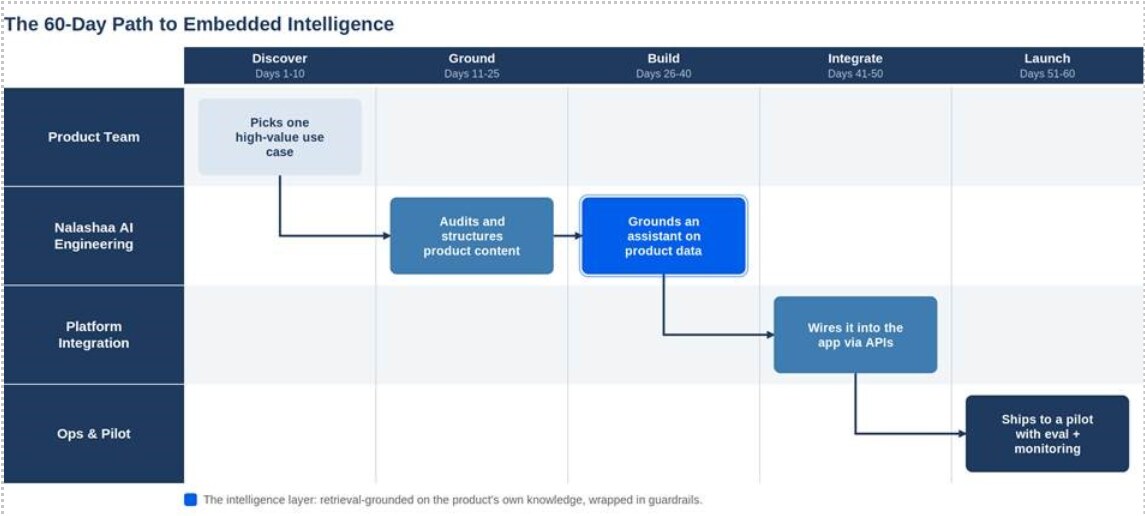
The 60-day path from a single use case to a shipped, grounded AI feature
The 60-day path from a single use case to a shipped, grounded AI feature, integrated through APIs so the platform is extended rather than rebuilt.

Key Capabilities Delivered

Beyond the approach, the engagement shipped a set of concrete, reusable assets rather than a one-off demo:

A production assistant

Scoped to the chosen workflow and live in the product for the pilot cohort.

A grounding pipeline

Retrieval over the product's own documentation and data, with a repeatable content-ingestion process for adding more sources.

API integration

Into the existing application and release process, ready to carry further use cases.

A usage and quality dashboard

Adoption, answer quality, and running cost, visible in one place.

An evaluation and guardrail harness

Wired into CI, so answer quality and safety are checked on every change.

Benefits of the Solution

In the 60-day pilot, the product owner measured:

01

Adoption by about 70% of the pilot cohort within the first month

02

Roughly 25% of routine questions answered in-product, deflecting them from support

03

An evaluation pass rate of about 90% on the grounded answer set, with guardrails holding responses on-topic

04

A working AI feature delivered in 60 days, with no platform rewrite and no roadmap freeze

05

A reusable foundation now extending to further workflows

Conclusion

The fastest way to make a product intelligent is rarely a moonshot rebuild. It is to embed one genuinely useful, well-grounded capability into the product customers already use, ship it to real users, and let usage guide what comes next. Scope discipline and clean grounding are what turn an AI ambition into a shipped feature in 60 days.

By combining a narrow first use case, retrieval grounding, and governance from day one, Nalashaa helped the product owner add intelligence to a mature SaaS platform without slowing the roadmap or compromising stability, and left a foundation ready for what comes next.

Ready to embed intelligence into your platform?

Let's discuss scoping a first use case, grounding it in your own product knowledge, and shipping it safely.

Let's Talk

Talk to an AI Product Engineering Expert

Tell us about your platform, first use case, and delivery goals. We will help you define a practical path from idea to a safe, production-ready AI capability.

Field will not be visible to web visitor