
Editor's Note
Here's a small disclaimer before you dive in. This article is not going to give you neat number-wise breakdowns or promise that "you will save X dollars" by doing one thing over the other. You won't find those kinds of headline numbers here. And that is intentional. AS400 migration and modernization decisions rarely work like that. Every environment is different, every application stack is different, and the cost outcomes depend heavily on your specific systems, integrations, and business priorities. So instead of throwing attractive numbers at you, this piece is meant to prepare you for the journey. The goal is to help you understand the trade-offs, the scenarios where each approach makes sense, and the factors you should be thinking about before making a decision.
When enterprises evaluate AS400 migration against AS400 modernization, the discussion usually starts with infrastructure cost. But that is rarely where the real economics sit.
The actual cost difference between migration and modernization comes from six areas:
- Infrastructure
- Labor
- tools
- adoption
- business disruption,
- and long term support.
A lift and shift style migration may look cheaper at first because it moves workloads quickly and shifts spending from capital expense to operating expense. But if the application remains tightly coupled, difficult to integrate, and dependent on old business logic patterns, the organization simply relocates technical debt instead of removing it.
AS400 modernization, by contrast, often carries a higher planning burden at the beginning because it may involve API enablement, UI modernization, modularization, refactoring, developer upskilling, and process redesign. But it can improve maintainability, preserve proven business rules, and create a more practical path to cloud, analytics, and AI adoption without forcing a full platform exit. IBM positions application modernization as a way to reduce costs and improve delivery flexibility, while IBM i modernization tooling such as Merlin specifically targets modernization of IBM i applications in hybrid cloud environments.
Understanding the financial impact of both options requires looking beyond infrastructure decisions. Organizations evaluating AS400 migration services or AS400 modernization services need to assess how each path affects operational continuity, development velocity, and long term platform sustainability.
Where AS400 Migration Usually Costs Less?
AS400 migration can often be cost effective when organizations adopt infrastructure focused migration strategies such as rehosting or limited replatforming. In these scenarios, the primary objective is to simplify infrastructure management while maintaining existing application functionality.
Running AS400 systems on premises requires organizations to maintain aging hardware, manage data center capacity, and support disaster recovery infrastructure. Moving workloads to cloud platforms shifts these responsibilities to the cloud provider and allows infrastructure costs to transition from capital expenditure to operating expenditure.
Because of this, many organizations begin their cloud journey with a rehosting approach. Applications are moved from AS400 environments to cloud infrastructure with minimal changes to the underlying codebase. This approach reduces migration timelines, avoids extensive application rewrites, and minimizes disruption to business operations.
Replatforming strategies can also offer a cost-effective path. Instead of rebuilding applications completely, organizations make targeted adjustments so systems can run more efficiently on modern infrastructure while preserving core business logic.
These approaches can reduce several operational costs:
- Infrastructure maintenance and hardware lifecycle management
- Data center electricity and cooling expenses
- Disaster recovery infrastructure management
- IBM hardware licensing and support costs
- Capital investment in new on premises systems
In many migration programs, infrastructure related operational costs can decrease by 30 to 70 percent once hardware management responsibilities are transferred to cloud providers.
However, the long term economics of a migration are influenced by how the architecture is planned.
Industry migration assessments show that when legacy workloads are replicated in the cloud without architectural optimization, operating costs can differ significantly from early projections. In one documented migration scenario, an organization expected annual cloud costs of approximately $66,000, but once the environment was running in production with continuously running compute instances, replicated database environments, and unoptimized storage configurations, the annual cost increased to more than $220,000.
Examples like this do not mean that cloud migration itself was the wrong decision. Rather, they illustrate how strongly migration outcomes depend on architectural planning and workload design.
When legacy systems are simply replicated in the cloud without optimization, the same inefficiencies that existed in on premises environments continue to operate within a usage based pricing model. As a result, infrastructure moves to the cloud while the underlying application architecture and operational complexity remain largely unchanged.
For this reason, organizations planning AS400 migration initiatives typically benefit from conducting a structured architecture and cost assessment before selecting a migration strategy. Evaluating workload patterns, infrastructure dependencies, and modernization opportunities helps ensure that migration decisions align with both operational goals and long term cost expectations.
Read more about how to prepare your AS400 environment for a successful migration.
Where AS400 Modernization Creates Cost Efficiency
AS400 modernization initiatives are typically pursued when organizations want to extend the value of existing IBM i systems while improving integration capabilities, developer productivity, and operational flexibility.
Unlike full system replacement, modernization focuses on improving specific layers of the existing platform. Business logic, transaction processing, and data structures that have supported operations for decades remain intact, while surrounding capabilities such as user interfaces, integration methods, and development environments are updated.
This approach allows organizations to improve system usability and connectivity without disrupting the core applications that support daily operations.
One of the most common modernization steps involves replacing traditional green screen interfaces with web-based or graphical user interfaces. Modern user interfaces improve accessibility for employees and partners while reducing training requirements for new staff. In many cases, organizations report productivity improvements because users can complete tasks faster through more intuitive workflows.
Integration modernization is another major source of value. Many AS400 systems contain critical operational data that remains difficult to access from modern applications. By exposing IBM i data through APIs and middleware layers, organizations can connect legacy systems with analytics platforms, cloud services, and modern business applications.
This enables companies to generate insights from legacy data while preserving the stability of the underlying system.
Developer productivity is also a significant cost factor. Traditional AS400 environments often rely on RPG or COBOL expertise, and experienced developers in these technologies are becoming increasingly scarce. Modernization initiatives frequently introduce tools such as RPG free format conversion, automated code analysis, and DevOps based development pipelines.
These improvements can reduce maintenance effort while making systems easier for modern development teams to maintain and enhance.
In some documented modernization programs, organizations have reported measurable operational improvements after targeted updates to their IBM i environments. For example, converting legacy Synon applications to modern RPG free format environments has helped companies reduce application maintenance effort by approximately thirty percent. In other cases, organizations that modernized data integration layers reported significant operational efficiency gains once legacy systems were connected to modern analytics platforms.
These improvements often come from several areas:
- Reduced effort required to maintain complex legacy code
- Lower reliance on scarce legacy development skills
- Improved productivity through modern user interfaces
- Faster development cycles enabled by modular architecture
- Reduced hardware and infrastructure management overhead
In many modernization programs, these operational improvements translate into lower long term maintenance costs and improved system agility.
However, the overall cost efficiency of modernization initiatives is influenced by several factors, including application complexity, the number of integrated systems, data structure dependencies, and the scope of the modernization effort itself.
Modernization projects can require investment in areas such as:
- code refactoring and restructuring
- user interface redesign
- API and integration layer development
- database restructuring or data model updates
- testing and validation of modernized applications
Because AS400 environments often support mission critical business processes, modernization programs typically follow a phased approach. Organizations often begin by modernizing interfaces or exposing APIs before moving into deeper architectural improvements.
This incremental strategy allows companies to validate improvements while minimizing operational disruption.
For this reason, many organizations conduct a structured modernization assessment before initiating large transformation initiatives. Evaluating application dependencies, integration patterns, development workflows, and business priorities helps determine which modernization approach will deliver the greatest operational value.
When modernization efforts are aligned with clear business objectives, organizations can extend the life of their IBM i platforms while improving usability, integration capabilities, and long term system sustainability.
The Real Cost Categories to Compare
A meaningful AS400 migration vs AS400 modernization cost analysis should consider multiple cost drivers rather than focusing only on infrastructure.
Infrastructure Cost
In a typical AS400 migration, organizations reduce capital expenditure associated with hardware ownership. Cloud platforms provide flexible infrastructure capacity and eliminate the need to manage physical servers and data center environments.
AS400 modernization, on the other hand, may retain portions of the existing infrastructure while modernizing applications and interfaces. Immediate infrastructure savings may therefore be smaller, but modernization often allows organizations to extend the useful life of their current systems while improving performance and usability.
Labor Cost
Labor costs vary significantly between migration and modernization strategies.
AS400 migration projects often require specialized expertise across several domains including cloud architecture, data migration, code conversion, and integration redesign. These projects frequently involve external consultants and multi phase testing cycles.
AS400 modernization projects also require specialized skills but can be executed incrementally. Organizations can modernize specific modules, workflows, or interfaces without rebuilding the entire system, reducing project scope and spreading labor costs over time.
Business Disruption Cost
Business disruption is one of the most underestimated costs in enterprise technology transformation.
Large scale AS400 migration projects often involve complex data conversion processes, integration rebuilding, and system cutover planning. During this period, the business may need to operate across both old and new environments, increasing operational complexity.
AS400 modernization usually introduces fewer disruptions because the core application environment remains operational while new capabilities are layered on top. This allows organizations to maintain business continuity while gradually modernizing the system.
Training and Adoption Cost
Migration initiatives typically require teams to adopt entirely new development platforms, infrastructure models, and operational tools.
Developers, administrators, and business users may need to learn new workflows, which can increase training costs and temporarily reduce productivity.
Modernization initiatives often involve smaller skill transitions. Developers can extend existing IBM i expertise while gradually incorporating modern frameworks, APIs, and web technologies.
Tooling Cost
Migration programs often depend on specialized tools for code conversion, database migration, testing automation, and cloud infrastructure management.
Modernization initiatives rely more on tools for UI modernization, API generation, application refactoring, and DevOps integration.
IBM's Merlin modernization platform is one example of tooling designed to accelerate application modernization by providing modern development workflows for RPG and COBOL based applications.
Long Term Support Cost
Long term support costs depend heavily on how the transformation is executed.
A pure AS400 migration may reduce hardware costs but can still leave organizations maintaining complex legacy logic within a new environment.
AS400 modernization, when implemented effectively, improves maintainability and integration flexibility. Over time, this can reduce support costs by simplifying application architecture and reducing manual operational dependencies.
Let's Design the Right AS400 Transformation Strategy Together
When Migration Makes More Sense
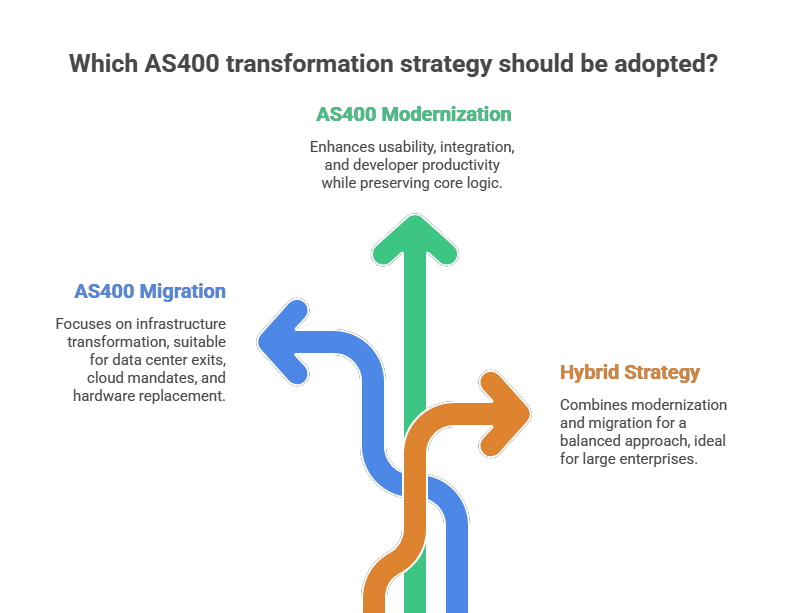
AS400 migration typically becomes the preferred option when the organization's primary objective is infrastructure transformation rather than application redesign.
In these situations, the priority is to move workloads to modern infrastructure quickly while maintaining existing application functionality.
Common scenarios include:
- Data center exit strategies
Organizations often migrate AS400 workloads when data center leases expire, facilities are consolidated, or infrastructure operations are outsourced. In these cases, rehosting workloads to cloud platforms can deliver faster infrastructure savings without requiring major application changes. - Corporate cloud adoption mandates
Many enterprises have internal targets for cloud adoption. When leadership sets goals such as moving a large portion of infrastructure to cloud platforms within a defined timeline, migration allows organizations to meet these objectives without waiting for full application modernization. - Hardware lifecycle replacement
IBM Power systems eventually reach end of support or require expensive hardware refresh investments. Migrating workloads to cloud environments can allow organizations to avoid new capital expenditure while extending the life of existing applications. - Infrastructure consolidation initiatives
During mergers, acquisitions, or IT consolidation programs, organizations often aim to reduce the number of physical environments they maintain. Cloud migration provides a scalable infrastructure model without requiring additional data center capacity. - Platform skill shortages
Many organizations also face talent constraints as experienced RPG and COBOL developers retire. In some cases, migration allows companies to shift operational dependencies toward broader cloud skillsets rather than relying exclusively on legacy platform expertise.
When Modernization Is the Better Investment
AS400 modernization becomes the stronger option when IBM i applications continue to play a central role in business operations and contain valuable business logic that organizations want to preserve.
Instead of relocating applications to new infrastructure, modernization focuses on enhancing usability, integration capabilities, and development agility while retaining the stability of the existing platform.
Organizations typically consider modernization when:
- Applications contain valuable business logic
Many IBM i systems contain decades of refined operational rules related to pricing, inventory, supply chain operations, and financial processing. Rebuilding this logic from scratch can introduce significant risk, making modernization a safer path for extending system capabilities. - Modern user interfaces are required
Traditional green screen interfaces can limit productivity and accessibility for modern teams. Modernizing user interfaces with web based front ends enables remote access, mobile workflows, and improved user experience without disrupting the underlying application logic. - Integration with modern platforms is limited
Legacy AS400 environments often lack modern API capabilities. Introducing REST APIs and integration layers allows IBM i systems to connect with cloud platforms, analytics tools, and modern enterprise applications. - Analytics and AI capabilities need to be introduced
Many organizations want to leverage real time analytics, machine learning, and AI driven decision systems. Modernization can expose IBM i data through modern data pipelines and analytics platforms without requiring a full system migration. - Developer productivity needs improvement
Modernization initiatives often introduce updated development practices such as RPG Free Format coding, automated testing frameworks, and DevOps pipelines. These improvements can significantly reduce maintenance effort while accelerating development cycles. - Operational stability is critical
In industries such as finance, manufacturing, and logistics, IBM i applications often support mission critical processes that cannot tolerate major disruption. Incremental modernization allows these systems to evolve while maintaining operational continuity.
Read more about the top AS400 modernization tools that help future proof IBM i systems.
How About a Hybrid Strategy? See What It's All About
In practice, most enterprises do not treat AS400 migration and AS400 modernization as mutually exclusive paths. Instead, many organizations adopt a hybrid strategy that combines elements of both approaches.
This model allows companies to modernize the most valuable parts of their IBM i applications while gradually evolving infrastructure where cloud platforms provide operational or economic advantages.
Hybrid transformation is increasingly common in large enterprises because it balances stability with innovation. Core IBM i systems often contain decades of embedded business logic that organizations prefer to preserve. At the same time, they want to introduce modern capabilities such as web interfaces, APIs, analytics, and cloud integration.
Industry modernization programs frequently begin by modernizing application layers before moving infrastructure.
For example, several large IBM i modernization initiatives have followed a phased model where user interfaces and APIs are modernized first while the core application environment remains stable. Once systems are accessible through modern integration layers, organizations gradually migrate selected workloads or data platforms to cloud environments.
In one enterprise transformation within the energy sector, an organization modernized its AS400 application layer to improve productivity while retaining its Db2 data environment for regulatory compliance. Infrastructure migration to cloud platforms was introduced later as a separate phase. This approach allowed the organization to improve usability and reduce maintenance complexity without disrupting mission critical operations.
Other enterprise modernization frameworks follow a similar path. Modernization platforms and consulting frameworks commonly combine several transformation techniques within a single roadmap. Non critical workloads may be rehosted in cloud environments, data platforms may be replatformed to support analytics, and high value applications may be rearchitected gradually.
Retail and distribution organizations have also used hybrid strategies when integrating legacy IBM i systems with modern data platforms. In some modernization initiatives, companies first exposed IBM i functions through APIs and integration platforms to enable analytics and customer facing applications. Only after these capabilities were established did organizations begin migrating selected workloads to cloud infrastructure.
Across these examples, the common pattern is clear. Organizations modernize interfaces, integration layers, and development workflows first, while infrastructure transformation occurs incrementally over time.
This hybrid strategy allows enterprises to:
- preserve stable business logic within existing IBM i systems
- introduce modern user experiences and APIs
- enable analytics and cloud connectivity
- migrate infrastructure selectively where it creates measurable value
By combining modernization and migration within a phased roadmap, organizations reduce transformation risk while enabling continuous progress toward a more flexible technology environment.
Final Thoughts
Well… are you ready to tell us what you actually expect from your AS400 environment? Every organization reaches a different conclusion depending on its applications, integrations, infrastructure, and long term business goals.
If you have made it this far, chances are you already have a clearer picture of what your system needs.
Kudos. The first step is done.
Now the real conversation can begin. Together we can evaluate where costs can be reduced, where investment actually makes sense, and how to ensure that short term decisions do not compromise long term ROI. Once we understand your environment and priorities, we can help you design a roadmap that balances cost efficiency, operational stability, and future innovation.