
Organizations that operate on the IBM AS400 ecosystem often find themselves in a difficult position when they begin modernizing their digital commerce experiences. The backend is reliable and battle tested, but it is slow to adapt. On the other hand, platforms like Shopify and Shopify Plus give businesses world class digital storefronts, fast merchandising capabilities, and scalable checkout experiences.
This creates a critical challenge. How do you maintain the stability of AS400 driven operations while offering a modern commerce experience on Shopify. The answer is an integration that is architected correctly and built to support both business and technical realities.
This guide explains why companies integrate AS400 with Shopify, how the data should flow, and what technical elements make the integration stable and future ready.
Why AS400 Shopify Integration Matters?
If you are running your business on AS400, you already know the story. The system holds everything that keeps operations alive. Customer records. SKUs. Stock levels. Pricing. Order history. Financial data. Fulfillment statuses. All of it sits safely in AS400, but the moment your eCommerce team tries to build modern experiences on Shopify, they hit a wall.
The problem is not Shopify. The problem is the gap between an old operational backbone and a fast moving digital storefront. When the two are not speaking to each other smoothly, the business feels it everywhere.
Integrating AS400 with Shopify changes that almost immediately.
From a business standpoint, the value is obvious:
You get a modern Shopify storefront without risking any of the critical processes running inside AS400. Inventory and pricing stay in sync. Orders move into AS400 instantly. Teams work with one version of truth. Operational teams gain real time visibility.
Technically, the benefits are just as significant:
Manual transfers disappear. Field level ownership becomes clear. Middleware protects data during outages. Architecture becomes easier to maintain and scale.
Step by Step Plan for AS400 Shopify Integration
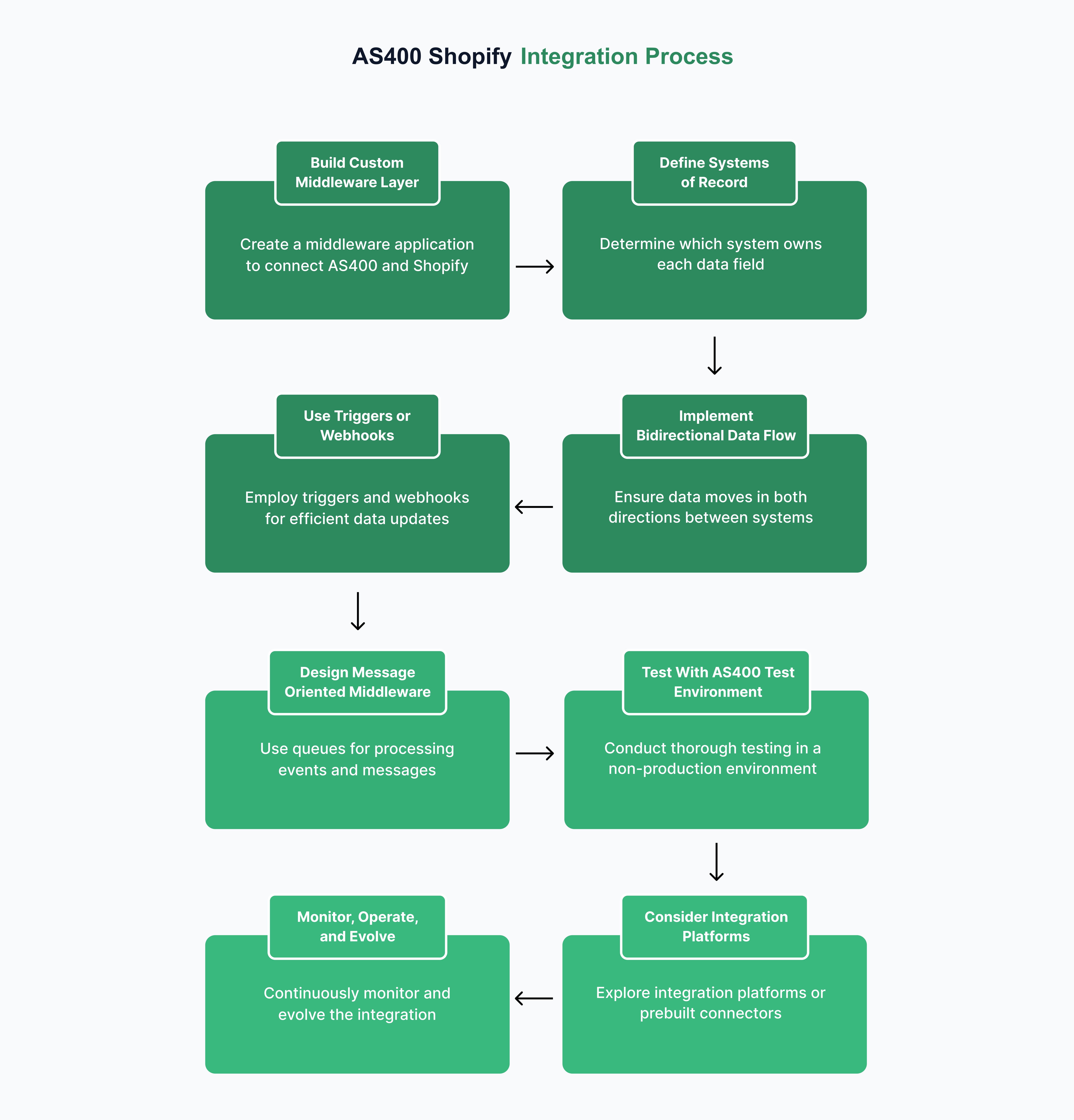
If AS400 is your operational core and Shopify is your storefront, the real work happens in the middle. A solid integration is not about a single connector. It is about following the right steps in the right order.
1. Build a Custom Middleware Layer
Start by accepting that you need a proper middle layer. AS400 is usually highly customized, so point to point integration is fragile.
Create a middleware application that connects to Shopify APIs and AS400 through approved integration methods.
2. Define Systems of Record For Each Data Field
Before moving data, decide who owns what. Shopify should control storefront data. AS400 should control operational and financial data. These rules must be enforced in middleware.
3. Implement Bidirectional Data Flow
AS400 should push products, inventory, and pricing to Shopify. Shopify should push orders, customers, and fulfillment updates back to AS400.
4. Use Triggers or Webhooks Instead of Constant Polling
Use AS400 triggers or logic to notify middleware when data changes. Use Shopify webhooks for real time storefront events.
5. Design Message Oriented Middleware With Queues
Convert events into messages, queue them, and process them with retries and error handling to ensure reliability.
6. Test With A Proper AS400 Test Environment
Always test in non production environments. Validate bulk sync and real time updates before going live.
7. Consider Integration Platforms Or Prebuilt Connectors
Integration platforms and prebuilt connectors can accelerate delivery and reduce long term maintenance.
8. Monitor, Operate And Evolve The Integration
Monitor logs, queues, and API limits. Set alerts and evolve the integration as business requirements change.
What Makes AS400 Integration Challenging?
AS400 was designed for stability, not real time digital commerce. Its customization, legacy formats, lack of native events, and embedded business logic make integrations complex and fragile if not handled correctly.
Do You Need Custom Integration or a No Code Platform
Custom middleware offers maximum control for complex AS400 environments. No code platforms offer faster delivery and simpler monitoring for standard workflows.
Common AS400 Integration Mistakes
Most failures happen due to poor architecture decisions, ignoring AS400 constraints, and underestimating long term operational requirements.
Treating AS400 Like a Modern Event Driven System
AS400 does not fire real time events on its own.
What goes wrong:
Teams expect instant sync without proper triggers. Excessive polling slows the system. Data updates become inconsistent.
What to do:
Use database triggers, controlled polling, or middleware queues designed specifically for AS400.
Not Defining a System of Record
This is the biggest source of data conflicts.
What goes wrong:
Pricing updates overwrite each other. Product descriptions disappear. Inventory numbers fluctuate.
What to do:
Decide ownership clearly. AS400 controls pricing, stock, and SKUs. Shopify controls descriptions, images, and merchandising data. Middleware enforces these rules.
Using Direct Point to Point Integrations
Point to point integrations look simple but become unmanageable quickly.
What goes wrong:
Hard coded logic spreads everywhere. Failures lack visibility. Extensions and maintenance become difficult.
What to do:
Use a middleware layer that manages mapping, business logic, retries, and error handling.
Ignoring the Legacy Business Logic Inside AS400
AS400 systems carry decades of rules for orders, pricing, and batch processing.
What goes wrong:
Integrations bypass validations. Batch processes break. Orders move without required checks.
What to do:
Respect existing logic and extend it without overriding core behavior.
Migrating Data Without Cleanup
Dirty data causes integration failures.
What goes wrong:
Duplicate products appear. Metadata is wrong. Mapping becomes inaccurate. Bad data spreads across systems.
What to do:
Perform data cleanup before integration. Even small fixes prevent major issues later.
Not Testing With Real AS400 Workflows
AS400 behaves differently under real operational load.
What goes wrong:
Batch jobs collide with sync timing. Locked records interrupt flows. High volumes slow the system.
What to do:
Test with real timing, real data volumes, and real business scenarios.
Missing Error Handling and Retry Logic
AS400 does not retry operations by default.
What goes wrong:
Orders get stuck. Inventory sync stops. Failures go unnoticed.
What to do:
Use queues, logging, and retry logic for every integration interaction.
Rushing Without Change Management
Users rely on long standing operational processes.
What goes wrong:
Warehouse teams get confused. Customer service sees incorrect data. Support tickets increase.
What to do:
Communicate early, train users, and roll out changes in phases.
Expecting a Single Connector to Solve Everything
There is no universal AS400 connector.
What goes wrong:
Tools fail with custom AS400 setups. Workarounds pile up. Costs increase without progress.
What to do:
Choose integration methods based on complexity, not convenience.
Skipping Post Integration Monitoring
Integrations require continuous oversight.
What goes wrong:
Syncs fail quietly. Batch jobs slow down. Errors surface weeks later.
What to do:
Monitor logs, queues, API calls, triggers, and performance continuously, especially in the first months.
Conclusion
AS400 Shopify integration works best when each system is allowed to do what it does best. Shopify delivers real time customer experiences, while AS400 ensures operational stability and trusted business logic.
The integration layer aligns both systems without forcing either to change its core behavior. With the right middleware, clear data ownership, and reliable synchronization patterns, you can modernize your storefront while keeping AS400’s backbone intact.
If you need guidance designing a stable, scalable integration tailored to your environment, AS400 integration experts can help you build the right approach from the ground up.