

AI-Powered QA: Cut Testing Time by 50% Without Losing Coverage

How a B2B SaaS provider used AI to speed up regression testing and release faster, while holding, and even widening, test coverage.

Talk to an Expert
Engineering team reviewing an automated test run
50%
Regression time cut on changed areas (8 hrs → 4)
+15%
Test coverage extended
12% → 3%
Flaky failure rate

Introduction

A B2B SaaS provider ships frequent updates to a platform relied on by operations teams across several industries, on a weekly release cadence. A QA team of eight kept a regression suite of about 2,500 automated tests green on every release. As the product grew, that suite grew with it, and so did the time and effort needed to maintain it.

Nalashaa partnered with the engineering team to bring AI into the existing quality assurance process, with a clear goal: cut the time regression testing added to each release without giving up the coverage the team depended on. The approach extended Nalashaa's established test automation practice rather than replacing it.

The Challenge

The team's automated suite worked, but it had become a bottleneck. Every release meant hours spent repairing tests that broke on minor UI changes, chasing flaky failures, and deciding what could safely be skipped under time pressure.

  1. 01

    Regression too slow: a changed-area run took about 8 hours, holding up weekly releases

  2. 02

    A heavy maintenance burden: roughly 18 hours of test repair per release as brittle scripts broke on small UI changes

  3. 03

    Flaky tests eroding trust: about 12% of failures were flaky, wasting triage time

  4. 04

    Pressure to release faster without dropping coverage across the 2,500-test suite

  5. 05

    Manual test creation acting as a bottleneck on new features

The task was to make testing faster and steadier at the same time, so speed did not come at the cost of coverage or confidence.

Our Solutions

Nalashaa layered AI onto the team's existing framework rather than starting over. The principle was practical: use AI to remove the repetitive, low-value work that slowed testing down, and keep engineers in control of what enters the regression suite.

01 / Maintenance Reduction

Self-Healing Test Automation

Tests were moved to a self-healing model that automatically adjusts locators when the interface changes, so minor UI edits no longer broke the suite. This removed the largest single source of maintenance effort, which published deployments consistently report as the biggest drain on QA time.
02 / Test Authoring

AI-Assisted Test Generation

AI drafted test cases from user stories and recent changes, giving engineers a running start on new coverage. Every generated test was reviewed in a pull request before entering the suite, so speed never came at the expense of correctness.

03 / Test Prioritization

Risk-Based Test Selection and Prioritization

Rather than run everything on every change, the suite selected and prioritized tests by code diff, component, and defect history. This built on Nalashaa's established practice of grouping tests by complexity, component, and priority, and it is what let cycle time fall while coverage of what mattered held firm.

04 / Failure Analysis

AI-Assisted Failure Triage and Flaky-Test Detection

When a run failed, AI clustered failures by likely root cause and flagged flaky tests, turning what used to be hours of diagnosis into a short, focused review. Real defects surfaced faster, and unstable tests were quarantined instead of eroding trust.

05 / Quality Governance

CI/CD Integration and Human-in-the-Loop Review

Everything ran inside the existing pipeline, so feedback arrived on every commit. Engineers approved AI-generated tests and self-healed changes through the normal review process, keeping quality decisions with the people accountable for them.

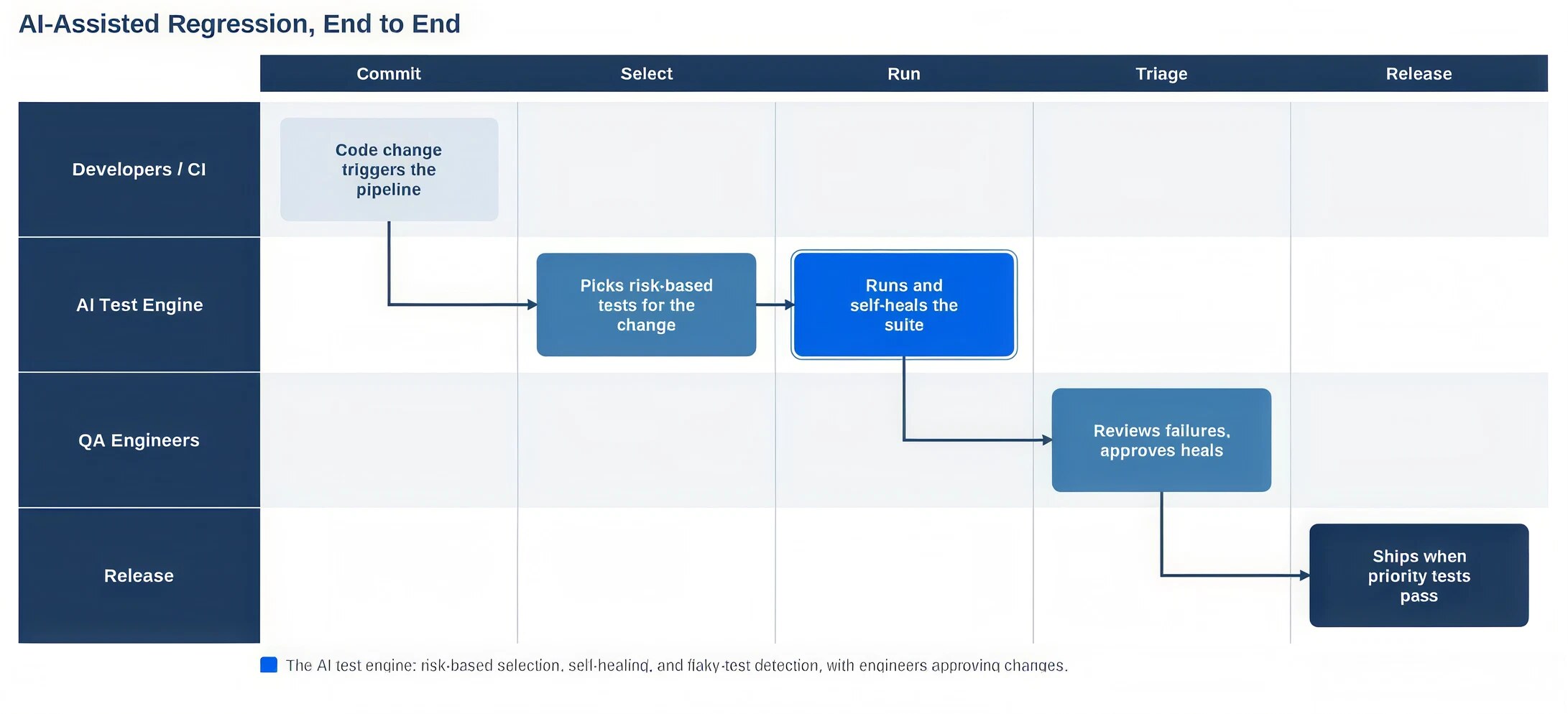
Pipeline diagram: risk-based selection, AI-run and self-healing tests, engineer review of clustered failures, then release
A change flows through the pipeline: risk-based selection chooses the tests, the AI engine runs and self-heals them, engineers review clustered failures, and the release proceeds when priority tests pass.

Key Capabilities Delivered

The platform enabled finance teams to:

Self-Healing Regression Suite

Tests that adapt to routine UI changes instead of breaking, cutting maintenance to a fraction of what it was.

Risk-Based Test Selection

The right tests run for each change, so cycles are shorter without leaving important paths untested.

AI-Assisted Authoring, Human-Reviewed

New coverage drafted by AI and confirmed by engineers before it enters the suite.

Faster, Cleaner Failure Triage

Clustered failures and flaky-test detection that turn diagnosis from hours into minutes.

Benefits of the Solution

With these changes in place, the team saw:

  1. 01

    Regression time on changed areas cut by about half, from roughly 8 hours to 4

  2. 02

    Test coverage held steady and extended by about 15%, as freed time went into new tests

  3. 03

    Faster, more predictable weekly releases

  4. 04

    Test maintenance cut sharply, from roughly 18 hours of repair per release to about 5

  5. 05

    Earlier defect detection, with the flaky failure rate down from about 12% to 3%

Conclusion

Speed and coverage are usually framed as a trade-off in testing. Applied with discipline, AI changes that equation: self-healing removes the maintenance that slowed teams down, risk-based selection focuses each run, and freed effort goes back into widening coverage rather than merely keeping the lights on.

By layering these capabilities onto an established framework and keeping engineers in the loop, Nalashaa helped the team cut the time testing added to each release while holding, and extending, the coverage the product depended on.

Want faster releases without losing coverage?

Let's look at where AI can take the maintenance and triage load off your QA cycle, safely.

Let's Talk