
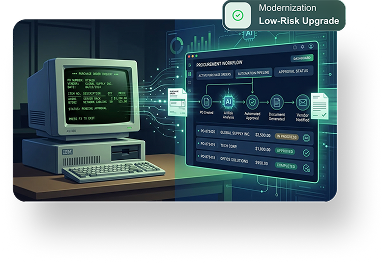
Automating Purchase Order Workflows from AS/400 for a Global Manufacturer

Talk to an Expert
AS400 purchase order workflow automation

Client Overview

A global industrial equipment manufacturer with operations across three continents relied on AS/400 to support core supply chain functions such as inventory management, procurement, goods receipt notes, and supplier management.

Their AS/400 environment was stable and dependable, but procurement workflows remained heavily manual. As order volumes increased and the supplier base expanded, the existing process could no longer keep pace with operational demands.

Challenges the Client Faced

Slow and Fragmented Purchase Order Processing

The client's PO lifecycle relied on AS/400 green-screen transactions, spreadsheet-based updates, email approvals, manual data entry, and batch updates into AS/400. This made the overall process slower than the business needed, especially during peak procurement cycles.

  • Purchase order creation, validation, and updates often took 2–3 days
  • Teams had to move between emails, spreadsheets, and AS/400 screens
  • Approved data was not flowing quickly into the live procurement process
  • Peak order periods increased delays across the workflow

Nalashaa’s Solution

Instead of replacing the AS/400 system Nalashaa focused on removing the manual work that surrounded it.

We started by looking closely at how the procurement team interacted with the system every day. Much of their time was spent navigating green-screen menus, entering data from supplier emails and documents, checking purchase order details, and updating records manually.

Automation Layer Around AS/400

Rather than changing the logic that the business relied on, we introduced an automation layer that works alongside the AS/400 environment. This layer reads supplier documents, validates information, updates purchase orders, and monitors the workflow for errors or exceptions while the core ERP continues to run the transactions.

RPA, AI, and Integrated Monitoring

Behind the scenes, this framework uses robotic process automation to interact with the green-screen interface the same way a user would, AI to read supplier documents and extract key values, and supporting integrations and monitoring bots to handle validations, updates, and reconciliation.

01

RPA Bot for AS/400 PO Creation

Nalashaa built a bot that logged into the AS/400 green screen and executed the same steps a procurement user would normally perform manually. The bot navigated menus, searched for existing material requisitions, read approved purchase requisition details, auto-filled supplier codes, populated pricing fields, created the PO in the correct module, generated the PO number, and logged it into the tracking system.

This removed hours of repetitive screen navigation from the procurement team’s daily workload.

02

AI-Powered Data Extraction from Supplier Files

Suppliers submitted documents such as order confirmations, price updates, acknowledgment files, and delivery notes. Nalashaa used AI to extract key values from these files, including quantity confirmations, delivery commitments, unit pricing, lead times, and special conditions.

Once extracted, this information was passed directly into the automation workflow so it could be validated and updated in AS/400 without manual re-entry.

03

Automated Supplier Update Posting into AS/400

Nalashaa deployed a second automation bot to manage supplier-side PO updates. This bot logged into AS/400, searched for the relevant purchase orders, updated acknowledgments, modified quantities and delivery dates, flagged mismatches for procurement review, and triggered exception notifications where needed.

This enabled supplier commitments to flow into AS/400 in near real time rather than through delayed batch processing.

04

Real-Time Procurement Visibility Dashboard

To improve operational visibility, Nalashaa created a Power BI dashboard that gave the procurement team a live view of PO cycle time, open purchase orders, pending approvals, supplier responsiveness, and exception cases.

This replaced static spreadsheet reporting and gave stakeholders a much clearer picture of procurement performance.

05

Error and Exception Management Bot

Nalashaa also implemented a bot dedicated to exception handling. It automatically checked for mismatched entries, flagged supplier anomalies, identified late supplier updates, and notified procurement team leads when intervention was needed.

This strengthened process integrity and improved compliance across the PO lifecycle.

Implementation Roadmap We Followed

  1. Discovery icon

    Discovery and scope

    Mapped AS/400 menus, conducted process walkthroughs, and documented exception rules.

    2 weeks
  2. Bot development icon

    Bot Development

    Built the green-screen automation layer and configured AI parsing models for supplier documents.

    4 weeks
  3. Integration icon

    Integration Layer Setup

    Set up the supplier update pipeline and supporting data workflow.

    2 weeks
  4. Pilot deployment icon

    Pilot Deployment

    Rolled out the solution for an initial phase, automating approximately 30% of PO volume.

    2 weeks
  5. Scale-up icon

    Scale-Up

    Expanded the solution to full production, automated 100% of targeted workflow, and enabled KPI dashboard visibility.

    2 weeks
Implementation roadmap workshop

Business Impact

PO cycle time icon

60% Reduction in PO Cycle Time

Purchase order creation time was reduced from two to three days down to approximately six to eight hours.

Manual effort icon

70 to 80% Reduction in Manual Effort

Procurement teams no longer had to spend hours every day navigating AS/400 screens for routine updates. That time was redirected toward supplier negotiations, risk management, and more strategic decision-making.

Data entry icon

40% Fewer Data Entry Errors

By combining AI validation with automated posting into AS/400, the client significantly reduced quantity mismatches, pricing errors, and incorrect delivery date entries.

Supplier responsiveness icon

Improved Supplier Responsiveness

Because supplier updates were processed in near real time, the organization saw faster confirmations, better delivery scheduling, and fewer misalignments across the procurement cycle.

Scalability icon

Greater Scalability

The automation framework enabled the procurement operation to handle seasonal demand spikes without increasing staffing levels.

AS400 modernization icon

Low-Risk AS/400 Modernization

The client achieved workflow modernization without changing AS/400 business logic. That meant no downtime, no upgrade risk, and no disruption to core business operations.

Looking Ahead

With procurement operations stabilized and automation workflows in place, the organization is now exploring additional modernization initiatives around its AS400 platform.

Future initiatives include expanding automation to:

Inventory icon

Inventory reconciliation workflows

During the project, the team identified that inventory discrepancies were often discovered late because reconciliation depended on manual checks across systems. Automating reconciliation workflows will help ensure inventory quantities remain accurate while reducing the effort required to validate stock records.

Production planning icon

Production planning updates

With supplier acknowledgments and delivery commitments now flowing into AS/400 more quickly, production planners can work with more reliable material availability information. Automating planning updates helps reduce delays and improves coordination between procurement and manufacturing teams.

Supplier analytics icon

Supplier performance analytics

With better visibility now available across purchase orders and supplier confirmations, the procurement team is also evaluating ways to analyze supplier responsiveness and delivery reliability more systematically. Building supplier performance analytics could help the organization identify patterns, manage supplier risk, and strengthen sourcing decisions over time.

Forecasting icon

Demand forecasting models

As order volumes continue to grow, the organization is also exploring forecasting models that combine historical purchasing patterns with current procurement data. This would help improve inventory planning, anticipate demand fluctuations earlier, and support more proactive replenishment decisions.

Talk to an Expert

Planning AS/400 procurement automation? Share your current workflow challenges and we will help define a practical rollout.

Field will not be visible to web visitor