
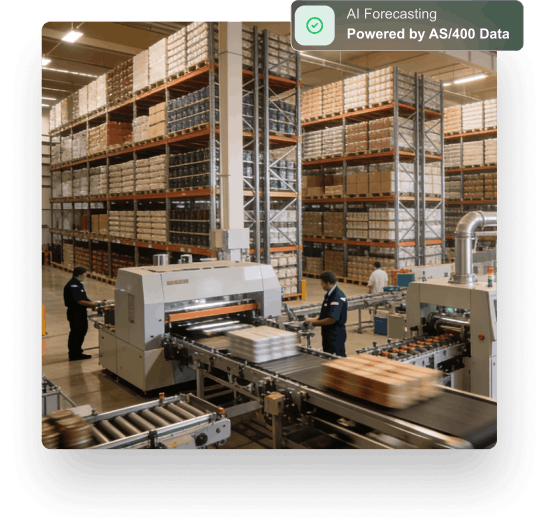
Predictive Inventory Forecasting Powered by AS/400 Legacy Data

Talk to an Expert
Predictive inventory forecasting on AS/400 data

Client Overview

The client is a global industrial component manufacturer operating three production plants across North America. Over two decades, its AS/400 environment had quietly accumulated a valuable transactional history including purchase orders, BOM consumption records, work orders, goods receipts, and supplier lead-time data, all stored in DB2/400 tables.

Despite this depth of historical data, inventory decisions were still being made manually. Planners relied on judgment, static safety stock rules, and spreadsheet-based reviews. The result was low-moving parts were overstocked, while high-velocity materials still ran short during active production cycles.

Challenges the Client Faced

Reorder Rules Sitting Inside the AS/400 That Nobody Had Updated in Years

The reorder levels for all 12,000+ products was inside the AS/400, but changing them wasn't as simple as editing a field. The rules were built into the system years ago, and updating them needed technical help that wasn't always easy to get.

So planners just left them alone and worked around them in spreadsheets. This is a big reason why inventory costs drifted up to 28% of the cost of goods sold.

Approaches Evaluated

Before recommending a path forward, we looked closely at how the business actually operated. Three plants running continuously across two continents. Twenty years of AS/400 history still in active use. Long-cycle spare parts that needed deep history to be forecasted reliably. And zero tolerance for production disruption at any site. With that picture in front of us, we evaluated two possible approaches for this client.

Approach A

Replace the AS/400 with a Modern System

The first option we considered was to migrate the last 5 to 7 years of inventory and demand data out of the client's AS/400 into a modern platform, train the forecasting engine on that migrated data, and retire the AS/400 once the new environment was stable.

We ruled this out for two reasons:

  • ×Migrating 20 years of live data would take multiple years with high disruption risk
  • ×Cutting to 5–7 years would remove critical history needed for long-cycle spare parts

01

Connecting to the AS/400 Without Touching It

We built a quiet integration layer that reaches into all three of the client’s AS/400 systems and pulls fresh data every six hours. It reads directly from the DB2/400 tables that already held their purchase orders, inventory, work orders, and demand history. Nothing inside the AS/400 had to change. No programs were rewritten. The system just started having a copy of the data in one place for the first time, ready to be analyzed.

This removed any need for the client to expose or modify their core AS/400 environment.

02

A Forecasting Engine Trained on Their Own 20 Years

Using 18 years of the client’s cleaned demand history across more than 12,000 parts, we trained a machine learning model to predict what each plant would actually need over the next 30, 60, and 90 days. The model learned from their real patterns — how products consumed raw materials, how long each supplier typically took, seasonal demand shifts, and regional industrial trends.

Long-cycle spare parts, which behave differently from everyday materials, were handled through a separate forecasting method built specifically for slow-moving, irregular demand.

03

Dynamic Reorder Point Engine

An optimization engine consumed forecast outputs and calculated dynamic reorder points and safety stock levels for every active SKU across all three plants. Unlike the static parameters previously locked in AS/400 that nobody had updated in years, these values adjusted continuously based on forecast variability, supplier lead times pulled from AS/400 history, and per-plant service level targets.

This replaced years of stale, manually maintained reorder rules with a system that adapted to actual demand.

04

Planner Dashboard and Stockout Risk Alerts

A planning interface gave demand planners across all three plants a live view of forecast vs. on-hand inventory at the SKU level, flagging items at near-term stockout risk or carrying excess stock beyond the recommended safety level. Planners could review, approve, or override recommendations before any action was taken in AS/400, preserving human oversight throughout the workflow.

This shifted planners from spreadsheet maintenance to decision-making.

05

Replenishment Write-Back into AS/400

Once planners approved recommendations in the dashboard, the integration layer wrote those actions directly back into AS/400, triggering purchase requisitions in POFIL, updating reorder parameters, and initiating inventory adjustments without manual re-entry. This closed the loop between AI-generated insight and operational execution within the existing AS/400 environment.

Every approved recommendation became an action inside AS/400 — without anyone re-typing a thing.

Implementation Roadmap We Followed

Discovery and AS/400 Data Audit

Mapped DB2/400 table structures across all three partitions, documented 140+ table relationships, and scoped remediation needs for three years of encoding-inconsistent records.

Middleware and Integration Layer Build

Deployed the JDBC extraction service, built the delta sync pipeline for all three plants, and validated data fidelity between AS/400 source tables and the normalized warehouse schema.

Data Cleansing and Feature Engineering

Resolved encoding issues, re-derived BOM consumption signals from work order history, and built seasonal and trend features for model training.

Predictive Model Development and Validation

Trained the XGBoost model across SKU segments. Backtesting against the most recent 24 months of actuals delivered 84% accuracy at 30 days and 73% at 90 days.

Replenishment Engine and AS/400 Integration

Connected forecast outputs to automated reorder logic and tested PO creation triggers back into AS/400 POFIL in a sandbox before production rollout.

Pilot Rollout at Plant 1

Rolled out to the primary plant covering 4,200 SKUs. Planners used the dashboard and predictive engine for 8 weeks; feedback was incorporated before broader deployment.

Full Multi-Plant Rollout and Optimization

Expanded to all three plants, activated cross-plant redistribution recommendations, and automated monthly model retraining using ongoing AS/400 delta feeds.

AI-powered inventory forecasting methodology

Business Impact

Results and business impact

Measurable outcomes within the first operating cycle

Results were tracked against a 12-month pre-implementation baseline across inventory efficiency, forecast quality, and operational productivity.

Significant Drop in Stockouts

Critical production materials were reordered earlier and more consistently, which noticeably reduced line stoppages caused by missing parts.

Around 35% Less Time Spent on Manual Planning

Planners shifted away from weekly spreadsheet reviews and spent more of their time on supplier conversations and sourcing decisions.

28%

Reduction in Inventory Holding Costs

Replacing fixed reorder rules with demand-driven ones cut down on overstocking of slow-moving parts across all three plants.

82%

Forecast Accuracy at 30 Days

The AI's short-term predictions were consistently more accurate than manual planning, giving the team a reliable view of what each plant would actually need.

Looking Ahead

With predictive forecasting live across all three plants and a stable connection to the AS/400 in place, the client is positioned to extend this foundation into other areas of the business, including predictive maintenance, supplier performance analytics, and a gradual, low-risk migration of AS/400 data over time.

Nalashaa continues to be the partner supporting both the day-to-day stability of the AS/400 environment and the longer-term modernization roadmap.

Running AS/400 and Thinking About Smarter Planning?

We can help you put your existing AS/400 data to work without replacing the system.

Field will not be visible to web visitor