
A reliability guide for engineering teams putting AI agents into production. The demo is the easy part. Here is how to engineer guardrails as a layered stack that holds up against drift, hallucination, and prompt injection once real users and real data arrive.
Shipping an AI agent at all is an achievement worth respecting. A working agent that reads a request, reasons through it, and takes a useful action represents real engineering, and the teams building these systems are solving genuinely hard problems. The trouble is that the demo and the production system live in two different worlds. A demo runs on clean inputs and a friendly tester who wants it to succeed. Production brings hostile inputs, edge cases nobody scoped, and the slow erosion of accuracy as the real world drifts away from the conditions the agent was built on. The gap between those two worlds is where most agent reliability problems live, and it is wider than a demo ever reveals.
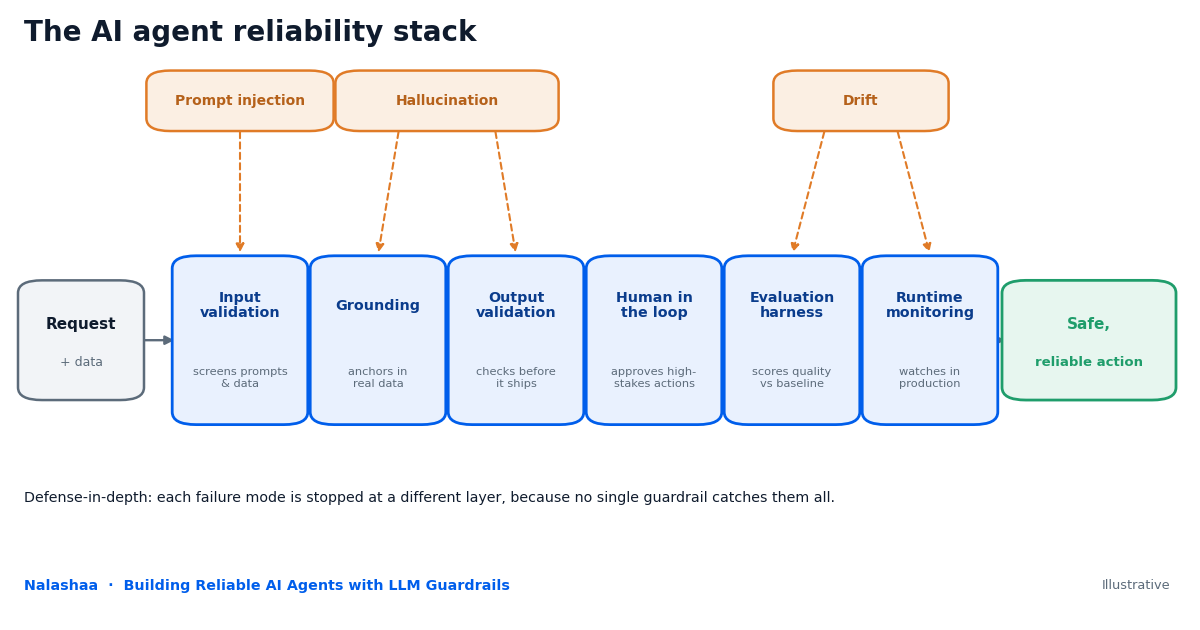
This is the gap LLM guardrails are meant to close, and the reason so many agents fall into it is a misunderstanding of what guardrails actually are. Treated as a single library you install before launch, guardrails catch one class of problem and miss the rest. Treated as a reliability discipline you engineer in layers, they hold up against the range of ways an agent can fail in the wild. The difference matters enough that an industry analyst has put a number on it.
Over 40%
Of agentic AI projects will be canceled by the end of 2027, according to Gartner, and one of the three named causes is inadequate risk controls. Most agents do not fail because the model is weak. They fail because the reliability engineering around them was missing.
Source: Gartner, June 2025.
Why AI agents fail in production even when the demo worked
The first thing to understand is that an agent fails differently from a chatbot, and the difference is what makes reliability harder. A chatbot that gives a wrong answer is visible immediately, because a person reads the answer and sees that it is wrong. An agent that takes a wrong action can change a record, send a message, or trigger a payment, and the mistake can cascade through downstream systems before anyone notices it happened. The cost of an error scales with what the agent is allowed to do, and a capable agent is allowed to do quite a lot.
Three failure modes account for most of the trouble, and each one needs a different defense. Prompt injection is an attack, where instructions hidden in the input or in content the agent reads hijack its behavior. Hallucination is an accuracy failure, where the agent states something false with complete confidence. Drift is a slow decay, where the agent gets less accurate over time as real-world inputs move away from what it was built and tested on. A single safeguard cannot address all three, because they enter the system at different points and behave in different ways. That is the core reason guardrails have to work as a set rather than a single check.
What LLM guardrails are, and why one library is not enough
LLM guardrails are the controls that keep a language model's behavior safe, accurate, and on-policy once it is running in production. In practice that covers screening what goes into the model, grounding its answers in real data, checking what comes out before it reaches a user or an action, and watching its behavior over time. Each of those is a distinct control with a distinct job.
The common mistake is to treat all of this as one thing you switch on. A team adds an input filter, marks the guardrails task as done, and ships. The filter does real work against malicious prompts, but it does nothing about a model that hallucinates from perfectly clean input, and it does nothing about quality that decays three months after launch. Every page that frames guardrails as a library to install shares this blind spot, because a library is one layer and a production agent needs several. The useful way to think about ai guardrails is the way security teams think about defense-in-depth: no single layer is trusted to catch everything, so independent layers each catch what the others miss.
Guardrails as a reliability stack, not a single checkpoint
The reliable version of an agent runs every request through a stack of controls, each defending a different failure mode. The table below lays out the layers and what each one is responsible for.
| Layer | What it does | Failure mode it defends |
|---|---|---|
| Input validation | Screens and sanitizes incoming prompts and data | Prompt injection |
| Grounding / retrieval | Anchors answers in real, current source data | Hallucination |
| Output validation | Checks responses against rules and sources before they ship | Hallucination, unsafe output |
| Human in the loop | Routes high-stakes actions for human approval | Costly autonomous errors |
| Evaluation harness | Scores quality continuously against a test set | Drift, regressions |
| Runtime monitoring | Watches behavior and quality in production | Drift, emerging failures |
Read top to bottom, the stack follows a request from the moment it arrives to long after the action is taken. The input is screened, the answer is grounded in real data, the output is checked, high-stakes actions wait for a human, and the whole system is evaluated and monitored on a continuous basis. No single layer carries the full weight, which is exactly the point.
A guardrail is a layer, not a feature
The word guardrail makes it sound like one thing you switch on, which is why so many agents ship with a single input filter and nothing else behind it. Real reliability works the way defense-in-depth works in security, where several independent layers each catch what the others let through. An input filter does nothing about a model that hallucinates from clean input, and an output check does nothing about a prompt injection that has already triggered a privileged action. You need the layers precisely because each of them fails in a different way.
How to defend against prompt injection, hallucination, and drift
The stack becomes concrete when you map each failure mode to the layers that stop it. Here is how the three named threats are actually defended.
Prompt injection
Prompt injection is the top security risk for LLM applications in the OWASP rankings, and it works by smuggling instructions into content the agent trusts. A document the agent was asked to summarize might contain a line telling it to ignore its instructions and export the data it can see. The defense is layered. Input validation screens incoming content for known attack patterns, least-privilege access ensures the agent cannot reach a dangerous tool even if it is tricked into trying, and output validation catches the unsafe result before it executes. The governing principle is simple to state and important to enforce: untrusted text should never be able to issue a privileged action. This is also where llm security stops being abstract, because an injected instruction that reaches a connected tool is a real breach, not a hypothetical one.
An agent that acts needs more than an agent that answers
The right amount of guardrail depends on what the agent is allowed to do. An agent that only retrieves information needs accuracy checks and logging. An agent that advises a person needs safeguards against overconfidence. An agent that takes action on its own, moving money, changing records, or sending messages, needs meaningful human review on the actions that carry real consequences, not a rubber-stamp of approval. Govern the agent by what it can do, rather than treating every agent as if it carries the same risk.
Hallucination
Hallucination is an accuracy failure, and the most effective defense is to stop the model from answering memory. Grounding the agent in real, current data through retrieval means it reasons from sources rather than from whatever it absorbed during training. Output validation then checks the response against those sources, and confidence thresholds let the agent escalate to a human when it is unsure instead of inventing an answer. The combination matters, because grounding reduces hallucination at the source and output validation catches the cases that slip through. This is the layer that earns an agent the right to be trusted, and trust is in short supply.
6%
of organizations say they trust AI agents to handle core, end-to-end business processes on their own, and only about 20% trust them for financial transactions. Guardrails are how an agent earns the trust to act on anything that matters.
Sources: Workato / HBR and PwC AI Agent surveys, 2025–26.
Drift
Drift is the quietest failure of the three, because nothing breaks and no alert fires. The agent simply gets less accurate as the real world moves away from the data it was built on, and the decline can run for weeks before a business metric exposes it. The defense lives in continuous evaluation and runtime monitoring. An evaluation harness scores the agent's quality against a fixed test set on a regular cadence, and runtime monitoring watches its behavior in production against a baseline, flagging the moment quality starts to slip. This is the same discipline that powers observability for any production model, which we cover in our guide to LLM observability for multi-model pipelines. Guardrails stop bad output, and observability catches the slow decay, which is why the two work as a pair.
Taking an AI agent from demo to production: a reliability checklist
Most of the gap between a promising demo and a dependable production agent comes down to a handful of engineering decisions. The checklist below captures the ones that matter most.
A reliability checklist before an agent goes live
- Validate every input. Treat all incoming text and data as untrusted, including content the agent was merely asked to read.
- Ground the answers. Connect the agent to real, current data so it reasons from sources rather than from memory.
- Validate every output. Check responses against your rules and sources before they reach a user or trigger an action.
- Limit what the agent can do. Give it least-privilege access to tools, so a bad instruction cannot reach a dangerous action.
- Put a human on the high-stakes actions. Require approval for anything irreversible or expensive.
- Watch it after launch. Monitor quality and drift in production, because the demo conditions will not survive contact with real users.
A customer-facing support agent is a clear example of all six working together, since it reads untrusted input, answers from documentation, takes actions on an account, and must stay accurate over time. We walk through that specific case in our guide to building ticket deflection that actually resolves.
How Nalashaa builds reliability into AI agents
The teams that keep their agents running past the pilot stage are the ones that build the reliability stack as part of the agent rather than as a layer bolted at the end. Doing that well takes judgment about which controls a given agent need, how strict each one should be, and where a human genuinely must stay in the loop.
Nalashaa's AI engineering team builds the full stack around your agent, covering input validation, grounding, output checks, evaluation, human-in-the-loop review, and runtime monitoring. That lets the agent hold up against prompt injection, hallucination, and drift once real users and real data arrive, rather than only in the demo. We design the guardrails alongside the agent, because reliability that is added at the end tends to be the reliability that is missing when it is needed.
Moving an AI agent from a promising demo to production?
Nalashaa builds the full reliability stack around your agent, from input validation and grounding to output checks, human-in-the-loop review, and monitoring, so it holds up against prompt injection, hallucination, and drift once real users and real data arrive. We engineer the guardrails as part of the agent, not as an afterthought before launch.
This is also the point where every thread in this series comes together. An agent has to run somewhere, which is the self-hosted versus cloud cost decision; it has to be watched in production, which is observability; and it has to be trusted to act, which is the guardrails work above.
The bottom line on building reliable AI agents
An agent rarely fails in production because the model is not smart enough. It fails because the reliability engineering around the model was missing, and the failure shows up as a hijacked action, a confident falsehood, or a slow slide in accuracy that nobody caught in time. The fix is not a better model or a single library. It is a stack of guardrails, where each layer defends a different failure mode and no layer is asked to catch everything on its own. Validate the input, ground the answer, check the output, keep a human on the actions that matter, and watch the whole thing in production. Build it that way, and your agent stays in the sixty percent that survive contact with the real world rather than the forty percent that do not.
Frequently Asked Questions
What are LLM guardrails?
LLM guardrails are the controls that keep a language model's behavior safe, accurate, and on-policy in production, covering input validation, grounding, output checks, and monitoring. They work best as several layers together rather than as a single filter.
How do you build reliable AI agents?
You engineer reliability as a stack: validate inputs, ground answers in real data, validate outputs, run an evaluation harness, keep a human on high-stakes actions, and monitor behavior in production. No single control is enough on its own.
What is prompt injection?
Prompt injection is an attack where malicious instructions hidden in user input or in content the model reads cause it to ignore its original task or take unintended actions. It is the top security risk for LLM applications in the OWASP rankings.
How do you stop an AI agent from hallucinating?
Ground it in real, current data through retrieval, validate its output against those sources, and set confidence thresholds, so it escalates instead of guessing. Hallucination drops sharply when the model answers from sources rather than from memory.
What are the layers of a reliable AI agent?
Input validation, grounding and retrieval, output validation, an evaluation harness, human-in-the-loop review for high-stakes actions, and runtime monitoring. Each layer defends a different failure mode.
Why do AI agents fail in production?
Usually not because the model is weak, but because the reliability engineering around it was missing. Gartner attributes a large share of agentic AI cancellations partly to inadequate risk controls.