
We have been doing RPA implementations for over 15 years. In that time, we have seen problems that repeat across clients, and we have seen new problems every time too. Every client is a little bit of a learning experience for us. Sometimes the fix is easy because we have solved something similar before. Sometimes it is new to us, and we figure it out with the client.
What we have learned over these years is simple: every industry and every business has its own set of problems, and those problems need dedicated attention. There is no one-size-fits-all RPA solution. On top of that, RPA itself keeps changing. AI is getting built into it, and client requirements keep shifting. What we built two years ago is not always the way we would build it today.
Below are real Nalashaa client engagements: the process that was broken, the bot that fixed it, and the numbers that came out the other side. Results range from a 98% cut in manual verification work to same-day invoice payments that used to take four days.
The market numbers back this up. Deloitte's intelligent automation research puts current adoption at 74% of organizations. Industry forecasts expect more than 75% of large enterprises to have RPA live by the end of 2026, across banking, healthcare, manufacturing, and retail. Most companies see a return within 6 to 9 months, with first-year ROI commonly between 100% and 200%.
The stories below are arranged by industry, so you can see how your peers solved problems you may be facing right now.
Healthcare
The Story Behind a 98% Drop in Eligibility Verification Time
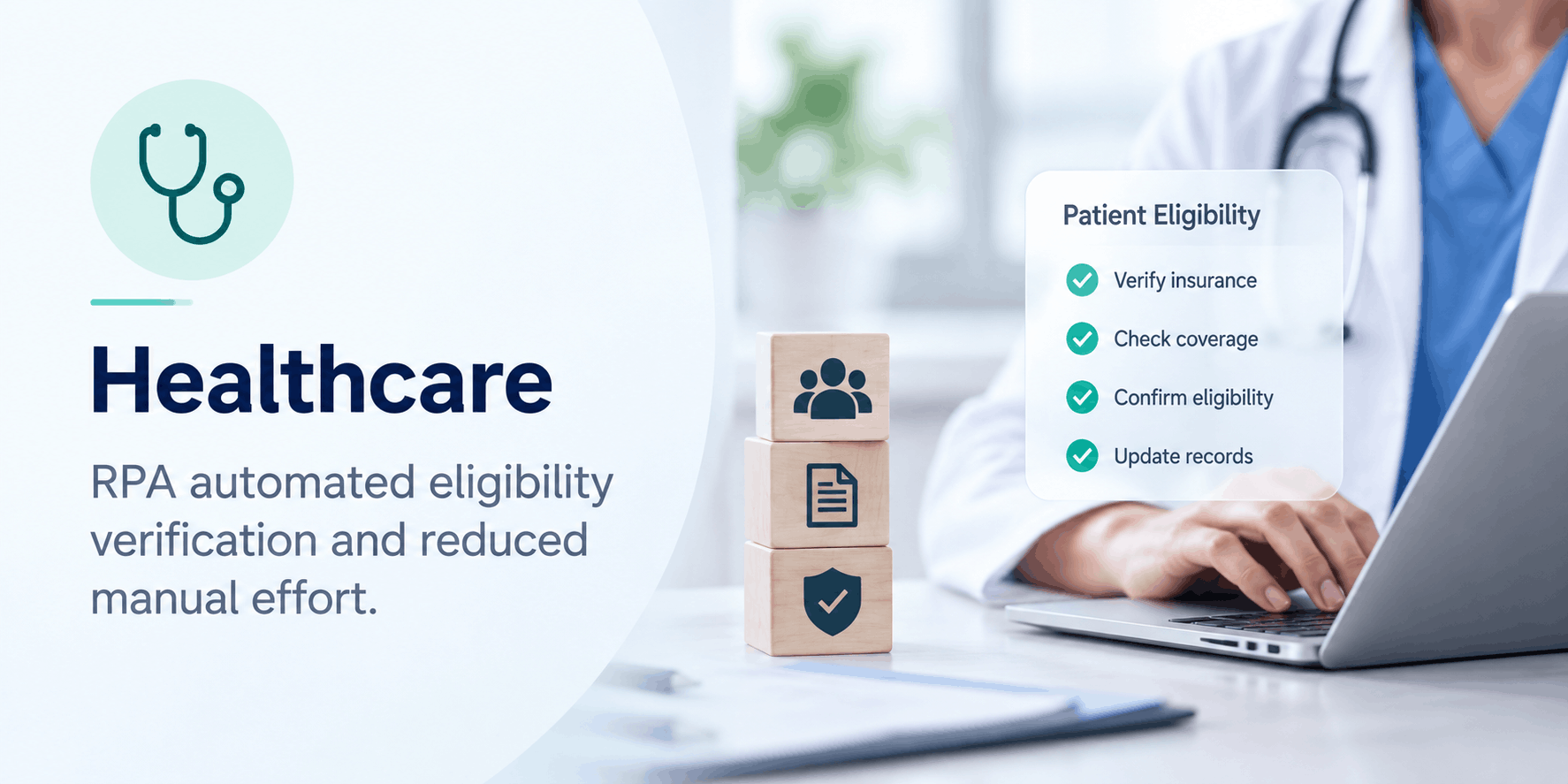
One of our clients, a urology provider in Georgia, came to us with a problem a lot of healthcare practices will recognize: patient insurance checks were eating up the whole day, every day.
Two staff members verified coverage against provider specialty, two more calculated and communicated estimated visit costs, and a manager chased down exceptions. On busy days, the clinic saw 1,000 to 2,000 patients, and each verification took about 13 minutes. That is over 200 staff-hours a day for a process that has to happen before every visit.
Nalashaa's team first sat down with the clinic's staff and mapped out, step by step, exactly how the eligibility process ran before touching any automation. Once the business rules were clear, an RPA implementation was built to run on a set schedule:
- Pull each patient's details from their upcoming appointment
- Log into the insurance plan's portal and capture co-pay, coinsurance, deductible, out-of-pocket amount, and network status
- Calculate the patient's estimated visit cost from that data and the provider's service charges
- Send the cost estimate to the patient through their preferred communication channel
- Flag any business-rule or system exception straight to staff, instead of a staff member having to go looking for problems
The bot ran unattended on the routine cases and only handed off to a person when something genuinely needed judgment.
The result: manual verification work dropped by over 98%. The clinic took on more patients without adding headcount, incomplete or non-payment cases fell by 20%, and revenue rose by 5%. Read the full eligibility verification case study.
Energy & Utilities
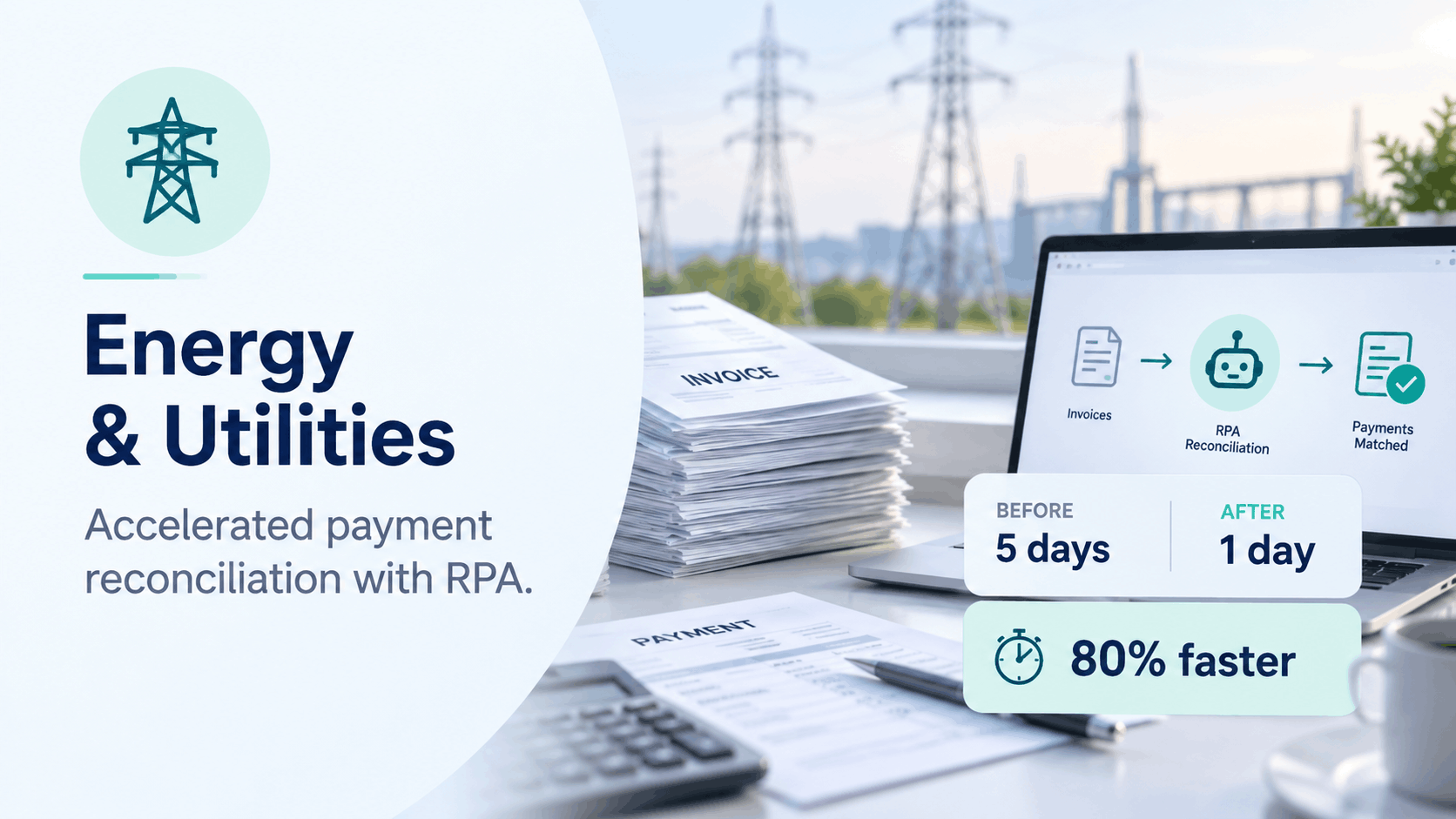
Turned a Slow Payment Matching Process Into an 80% Faster Workflow
A Texas-based energy service provider serving 3 million retail customers across 10-plus states ran its billing and payments through a central CRM. Every time a customer paid a bill, their bank sent back a transaction file that a staff member had to manually match to the right customer profile. At that volume, the matching was slow and error-prone.
Nalashaa's subject matter experts started by mapping the end-to-end reconciliation workflow and sitting down with the ESP's stakeholders to pin down the exact business rules and exceptions the process ran on, before writing any automation. The bot that came out of that analysis works like this:
- It opens each incoming payment file from the customer's bank and reads the payment and customer information inside it
- It matches that data to the right customer profile and updates the CRM directly, no manual re-entry
- If it hits an anomaly it can't resolve on its own, it emails an error report straight to an ESP employee instead of stalling
- At the end of each run, it publishes a project status report the stakeholders can act on
Nothing sat in a queue waiting for someone to notice it; the bot's own exception path did that job.
Transaction processing time fell by 80%, manual effort dropped by 98%, reconciliation errors declined sharply, and both customer and employee satisfaction scores went up.
Have a process like these?
Talk to our RPA experts and find out what automation could do for it
Book a 30-minute callLogistics
Fixed Scheduling Delays, Tracking Gaps, and Invoice Errors with RPA
A Dallas-based trucking company with 250 vehicles across four facilities was growing faster than its manual processes could keep up. Three areas were creating most of the operational drag: appointment scheduling, shipment tracking, and invoice validation. Each involved repetitive work, information spread across different systems, and too much dependence on employees to keep things moving.
Nalashaa started by looking at how each process actually worked. For appointment scheduling, employees were manually balancing pickup and delivery locations, delivery windows, driver availability, and vehicle requirements. We automated that decision flow so staff could enter the shipment details into a digital sheet and let the bot generate a proposed schedule. When a case fell outside the defined rules, it was sent to a service agent for review rather than forcing the entire process back into manual handling.
The shipment tracking process had a different problem. Agents were searching through emails, files, carrier portals, and third-party logistics systems just to answer a customer's request for an update. We introduced bots that periodically collected tracking information from those sources, standardized it, and pushed it into the CRM. This gave service agents and the AI chatbot access to the same current shipment information. The automation also handled ETA notifications and updated the workflow when delivery dates or destinations changed.
For invoice validation, the challenge was both volume and inconsistency. A 20-person team was manually checking invoices arriving in different formats, which was contributing to frequent errors. OCR-enabled bots were introduced to read the invoices, compare them with bill-of-lading and carrier information already available in the CRM, and send validated invoices directly into the ERP for payment processing. Anything that failed validation was automatically routed to the appropriate employee instead of sitting unnoticed in an inbox.
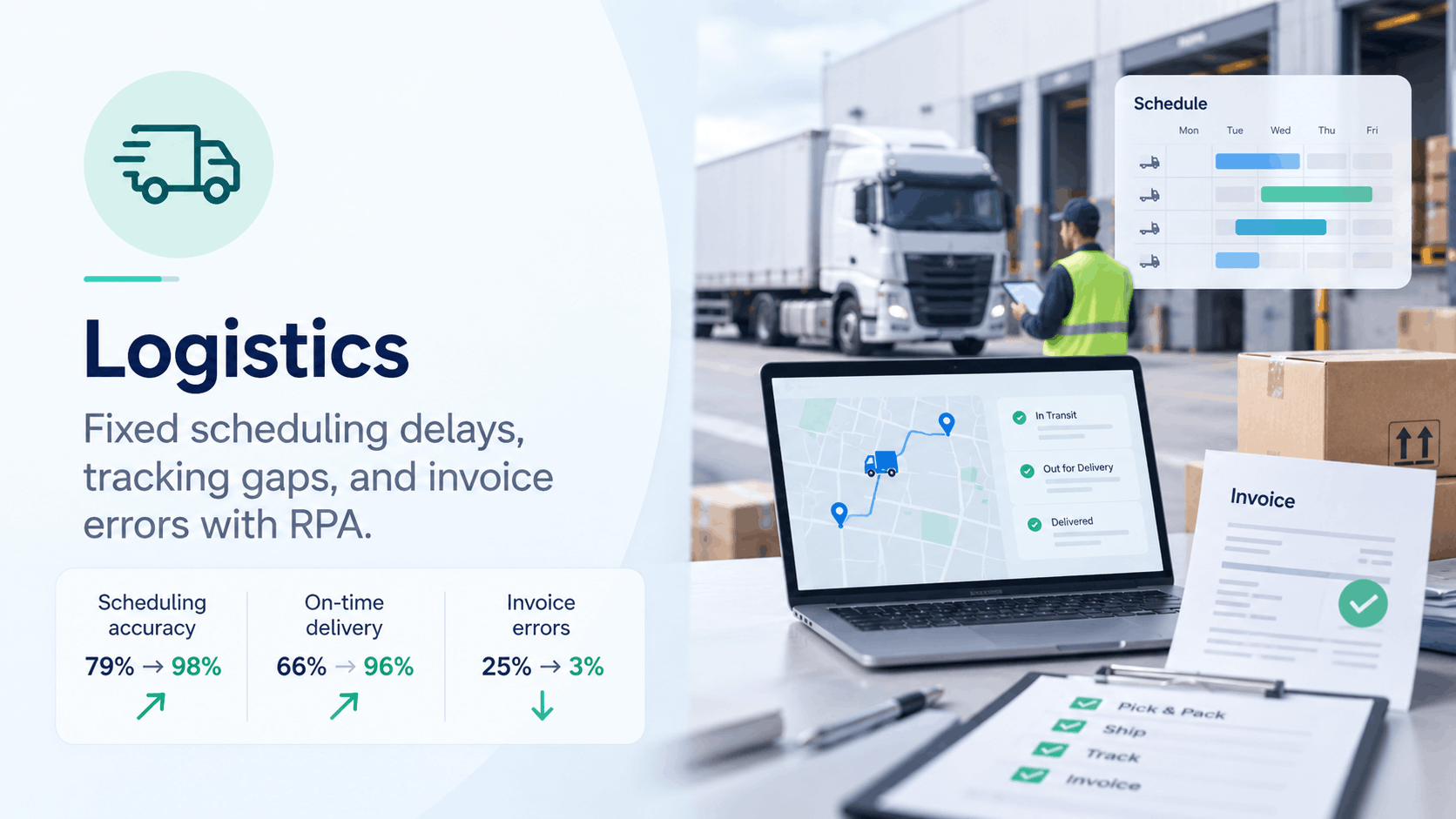
The improvements were visible across all three processes. Scheduling accuracy increased from 79% to 98%, while scheduling time fell from 15 minutes to 2 minutes. Shipment tracking required fewer customer calls, and on-time delivery conformance improved from 66% to 96%. Invoice errors dropped from 25% to 3%, the invoicing team decreased from 20 people to four, and average payment time moved from four days to same-day processing.
Read the full logistics automation case study, or explore how RPA for logistics can help automate similar processes across your operations.
Education
Reduced Alumni Management Workload by the Equivalent of 2–3 Employees with RPA
One of the world’s oldest higher-education institutions had a large alumni database in its CRM, but much of the work around it was still manual. Administrative staff were adding new graduates, sending birthday messages, requesting contact updates, updating CRM records, and preparing alumni-event invitations by hand.
As the database grew, that workload started creating backlogs, data inaccuracies, missed updates, and less time for staff to focus on students and other higher-value work.
Nalashaa looked at how these activities moved between the CRM, email, and Google Forms, then automated the repetitive steps across the alumni-management process.
The bots were designed to handle tasks such as:
- Monitoring incoming emails for graduating-student information
- Validating names and registration details against CRM records
- Adding eligible graduates to the alumni association group
- Sending onboarding and confirmation emails automatically
- Requesting contact updates through Google Forms and updating the CRM when responses came in
- Filtering alumni by graduation year for event and outreach campaigns
- Sending exception notifications and screenshots to IT when something required review
The automation was also extended to recurring alumni engagement. Bots could identify upcoming birthdays in the CRM, personalize messages using predefined templates, and send them without requiring staff to manage the process manually.
For contact updates, the bot monitored form responses, checked the submitted information against existing CRM records, updated changed details, and sent confirmations to both the alumnus and the administration team.
Quarterly alumni-event outreach followed the same pattern. Instead of staff manually building lists and preparing emails, the bot filtered the right alumni groups and handled the communication automatically.
The result was an alumni-management process that required far less day-to-day manual intervention. Data entries and updates that previously consumed administrative time could be completed in seconds or minutes, while daily reports gave the team visibility into requests received and actions completed.
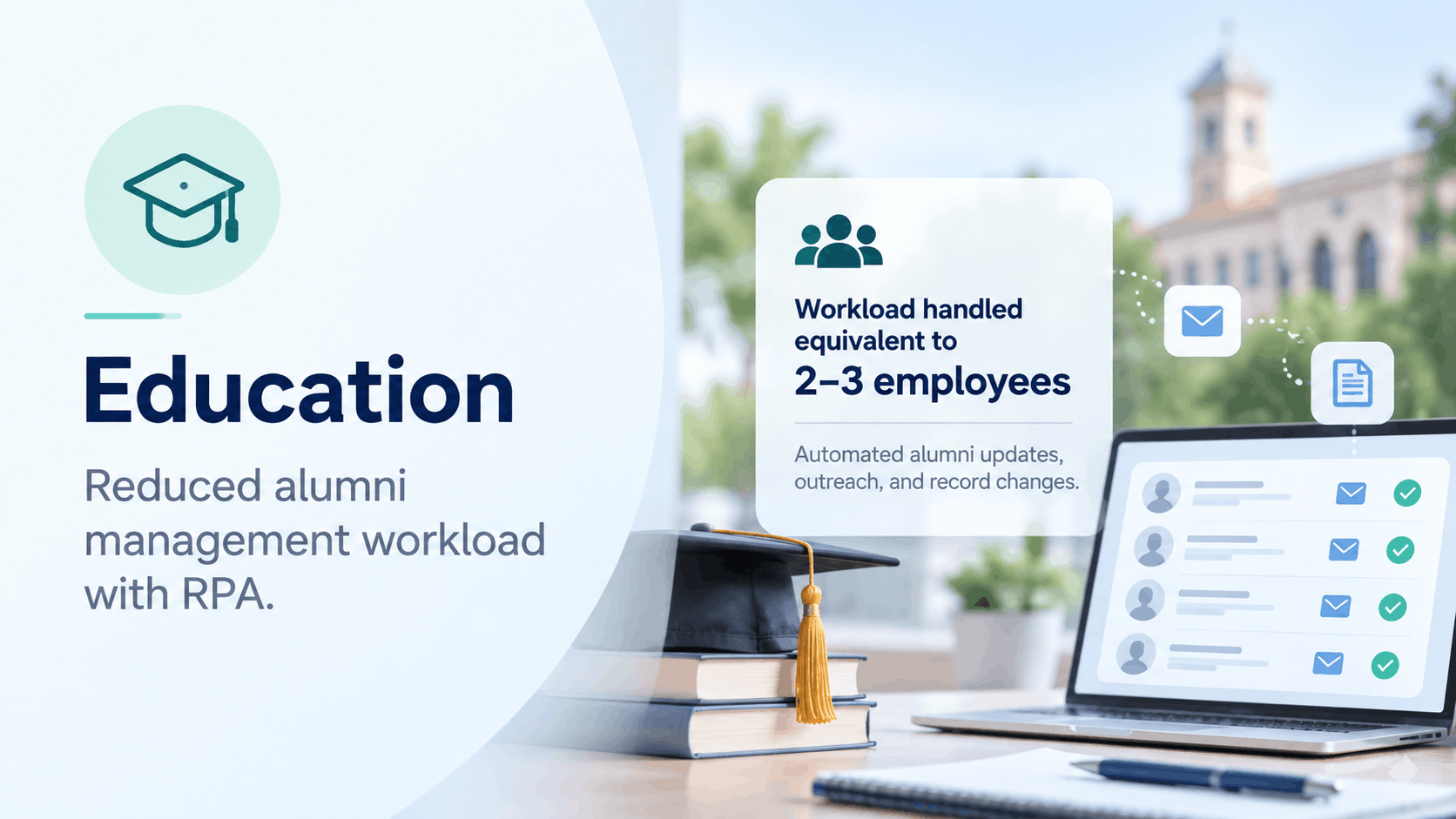
The deployed bots were able to handle work equivalent to two to three employees, allowing staff to spend more time on academic and student-facing priorities.
If you’re facing similar challenges in education, explore our RPA for Education service to see how automation can simplify repetitive processes, reduce manual effort, and improve operational efficiency.
Media & Entertainment
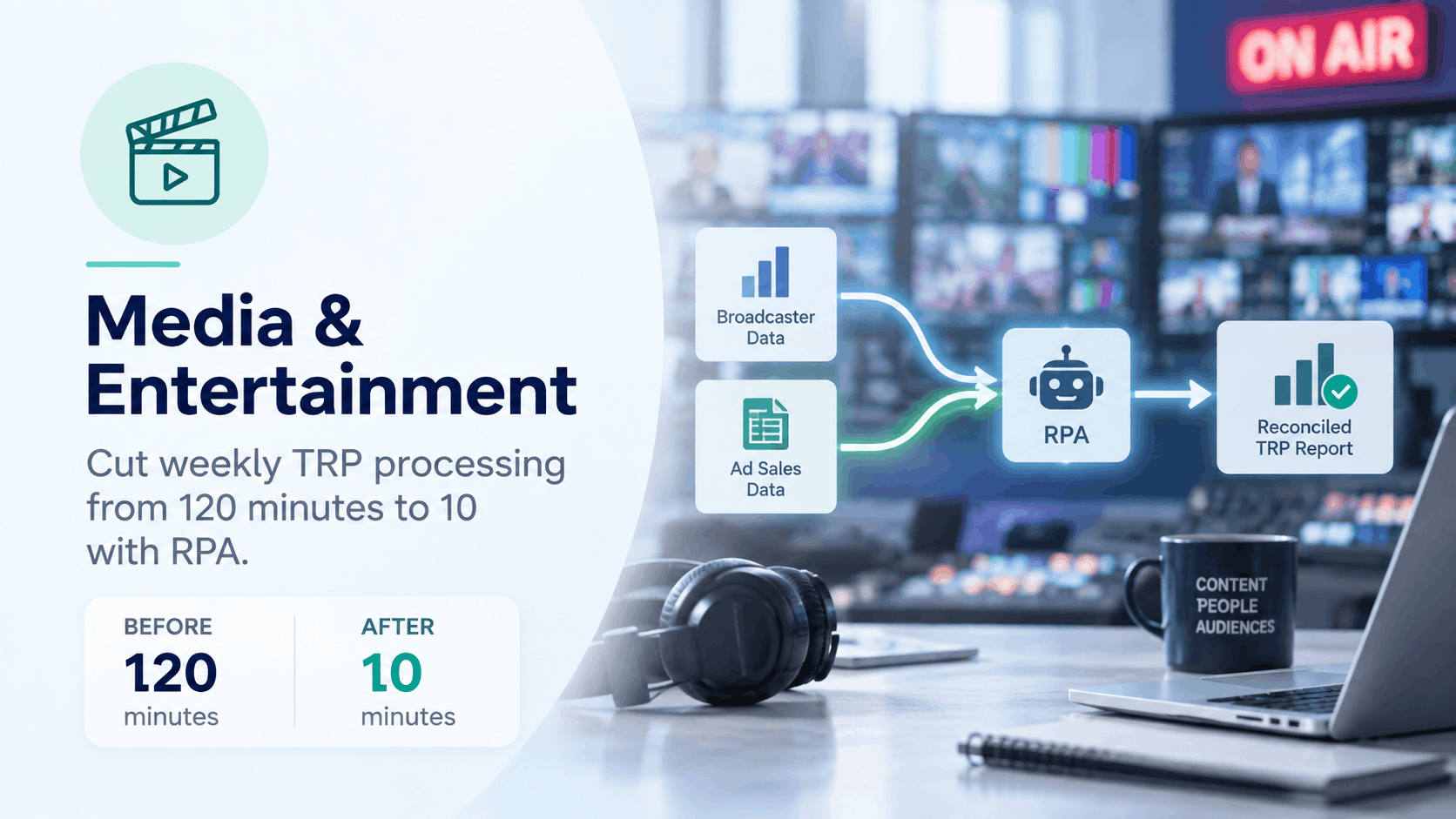
Cut Weekly TRP Processing from 120 Minutes to 10 with RPA
One of India’s largest television networks, operating 60 channels and reaching around 790 million viewers each month, relied on weekly TRP data to understand how its programs and channels were performing. The problem was that preparing those numbers required employees to manually work across two different data sources, reconcile the information, and prepare it for analytics.
The process pulled audience data from BARC Media Works and spot data from MAFRAS/Markdata. With so much manual extraction and reconciliation involved, errors could affect the TRP numbers and ultimately give the business an inaccurate picture of channel and program performance.
Nalashaa automated the workflow from data collection through reconciliation and delivery. The bot now:
- Logs into BARC Media Works and downloads the latest weekly TRP data
- Captures figures such as channel, week target, rating percentage, GRP, and channel group
- Authenticates into MAFRAS and manages the required channel subscriptions
- Downloads the corresponding spot data in Excel
- Compares BARC and Markdata figures across channel-level GRP, channel-group GRP, and Free Commercial Time
- Pushes the reconciled file into the ETL process for downstream market analysis
- Sends process-status updates to the relevant stakeholders once the run is complete
The important change was that employees no longer had to repeatedly extract, compare, and reconcile the two datasets themselves. The automation took over the repeatable work while building validation directly into the process before the data reached the analytics environment.
The impact was substantial. The process went from requiring five FTEs to one, daily processing capacity increased from 5 transactions to 50, and average processing time dropped from 120 minutes to 10 minutes per transaction.
Banking & Financial Services
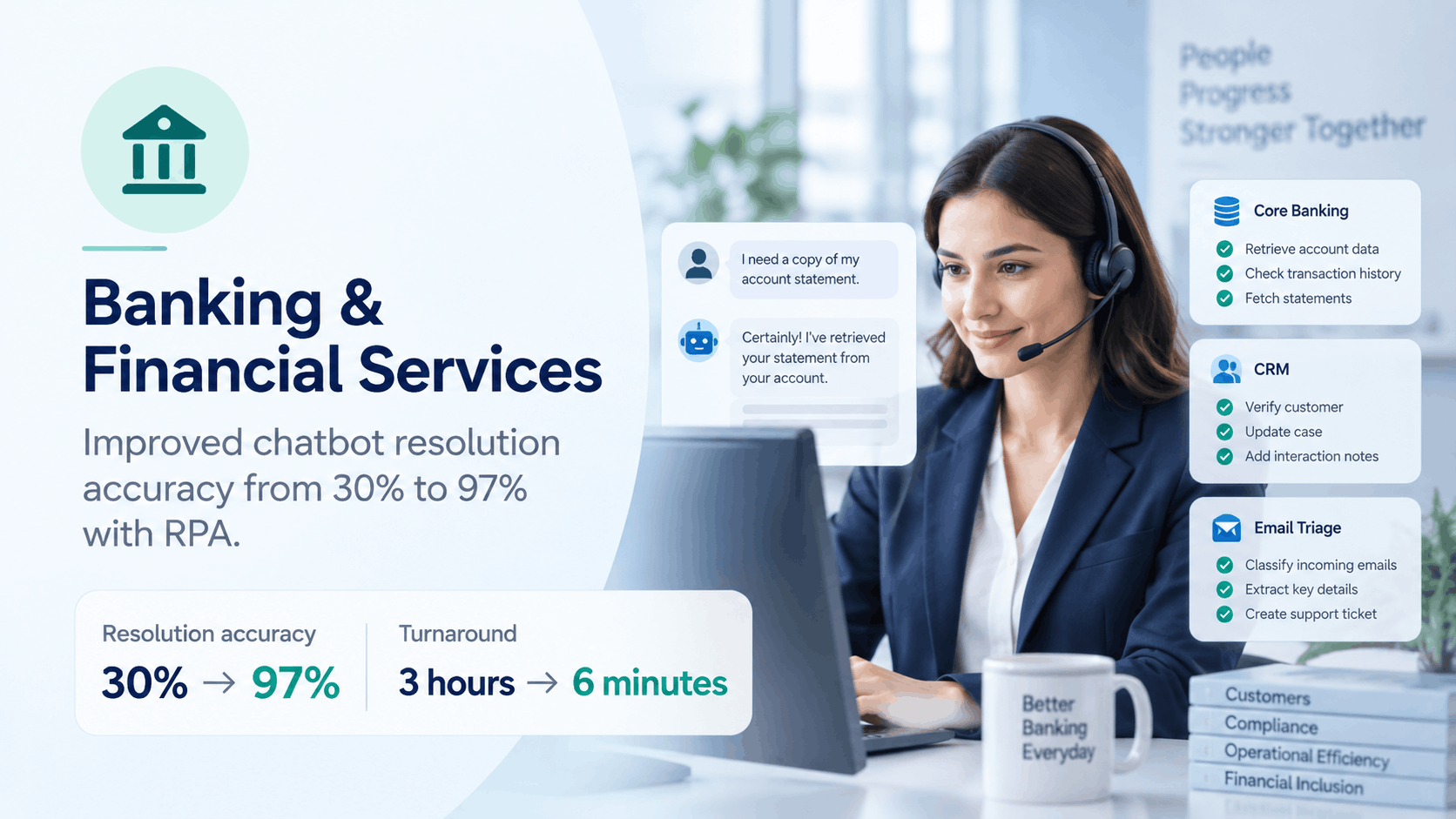
Improved Chatbot Resolution Accuracy from 30% to 97% and Cut Turnaround from 3 Hours to 6 Minutes with RPA
A 15-year-old mid-sized bank in Richmond, Virginia had a chatbot that resolved only around 30% of queries correctly, since it had no way to pull live data from the CRM or core systems; almost everything else escalated to an agent with a multi-hour turnaround. Nalashaa replaced it with an NLP chatbot wired into an RPA back-office bot: the chatbot verifies the customer, the bot retrieves the answer from wherever it lives, and only the hardest cases still go to a human. A parallel fix applied the same logic to the support inbox, using a machine-learning read of each email to classify, prioritize, and route it automatically. The results, before and after:
| Before | After | |
|---|---|---|
| Chatbot case resolution accuracy | 30% | 97% |
| Chatbot average turnaround | 3 hours | 6 minutes |
| Chatbot staffing | 4 | 1 |
| Customer support operating costs | — | down 22% |
| Email triage accuracy | 67% | 94% |
| Email average turnaround | 24 working hours | 15 minutes |
| Email staffing | 2 | 0 |
Is this close to a problem you're dealing with?
Our RPA experts can walk through it with you
Schedule a Call TodayManufacturing
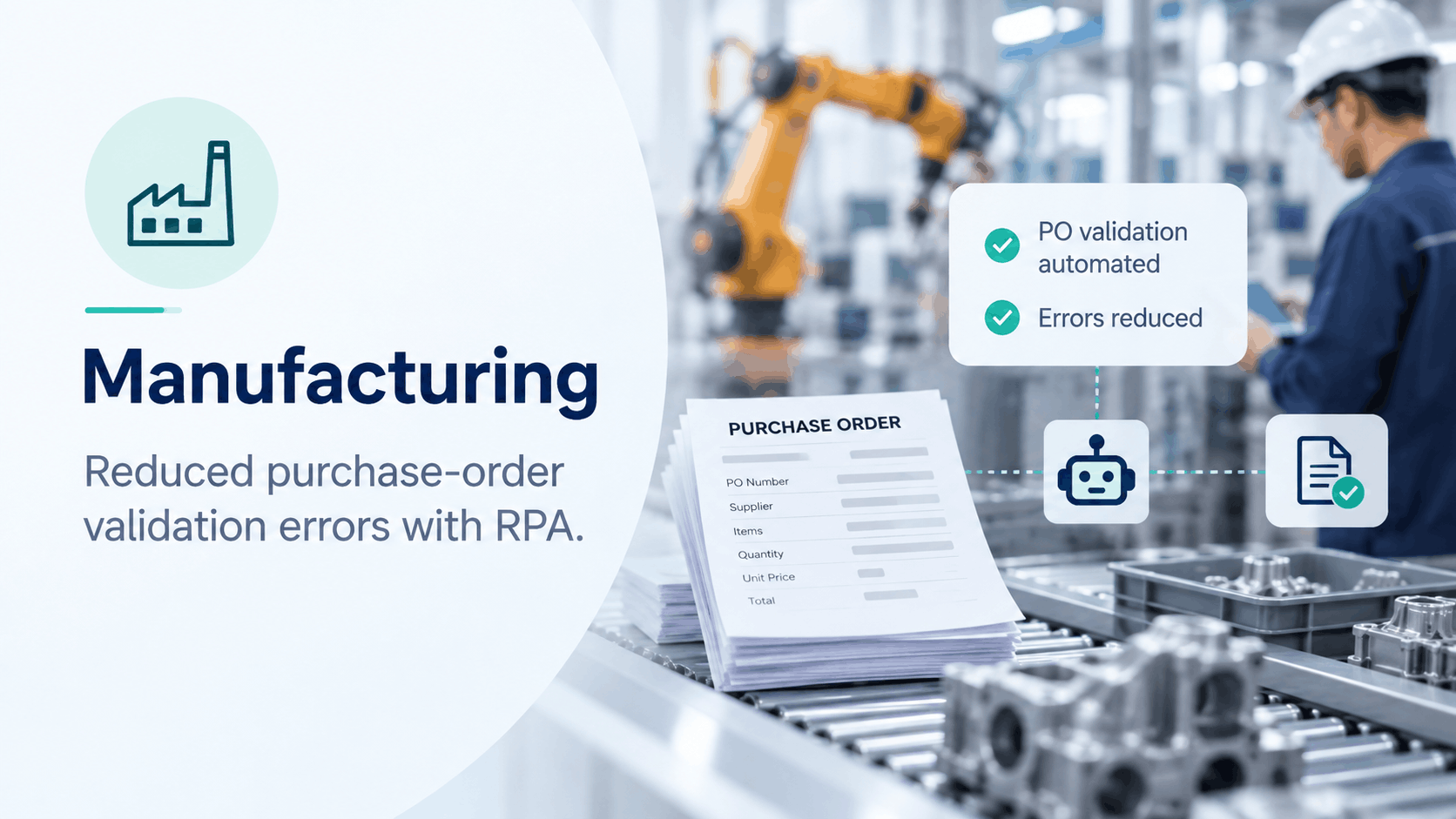
Fixed Purchase Order Errors and Slow Account Reconciliation with RPA
An Austin-based manufacturer of pumps and pumping solutions was processing a high volume of purchase orders from vendors every day. The problem was that validation was still largely manual. Incorrect quantities or items, delayed approvals, and inaccurate delivery dates were slipping through the process, which eventually affected fulfillment and sales.
Nalashaa first studied the complete PO workflow to understand where those errors were entering the process. Instead of automating only the data entry, the team built validation into each stage so every incoming purchase order could be checked before it moved forward.
The bot now:
- Identifies purchase order emails and extracts the attached PO
- Checks whether the document is in the correct format
- Validates the sender and item information against database records
- Compares ordered quantities with the latest inventory data
- Sends the customer an automated update with the order status and estimated delivery date
- Notifies the fulfillment team when an order is ready to proceed
- Alerts the relevant stakeholders when stock is unavailable or a PO fails validation
This moved validation from a manual check at the end of the process to an automated control built directly into the workflow. The manufacturer could process orders more consistently while reducing the risk of incorrect quantities, products, or delivery commitments reaching the next stage.
Calculate Your RPA Automation Cost
Curious what an automation like this would cost for your own process?
Try Nalashaa's RPA Cost Calculator and get an instant estimate based on your process setup.
RPA Cost Calculator
Need a customized solution?
Get the estimated cost of our RPA Implementation services as per your business set up.
Estimated Cost
$0
Total Days
0
Our RPA Delivery Approach
While every RPA engagement has different business requirements, our delivery approach follows a consistent structure from discovery through post-deployment optimization.
Process Discovery and Documentation
We begin by mapping the process as it operates today, including manual steps, system interactions, dependencies, and exceptions. Working directly with the teams performing the process helps uncover workarounds and edge cases that may not appear in formal documentation.
Automation Feasibility Assessment
Not every repetitive task is suitable for RPA. We assess transaction volumes, systems involved, process stability, business rules, exceptions, and the level of human judgment required.
Workflow and Bot Design
Once the process and rules are clear, the automation is designed around the actual workflow. Depending on the requirement, this may involve RPA platforms such as UiPath along with OCR, document processing, or machine learning where information is unstructured or inconsistent.
Exception and Scenario Testing
Testing covers more than the standard transaction path. Bots are tested against missing data, system failures, unexpected document formats, timeouts, and other exceptions that occur in day-to-day operations.
Clear escalation paths are also defined for cases that require human review.
Phased Deployment
For complex, regulated, or business-critical processes, automation is introduced in stages rather than deployed across the entire workflow at once.
This allows each part of the process to be validated before additional rules, integrations, or automation layers are introduced.
Monitoring and Continuous Improvement
After deployment, we monitor bot performance, exception rates, processing accuracy, and escalation patterns. As business processes, source systems, and automation capabilities change, the workflow can be refined to improve reliability and expand the level of automation.
Right Call Starts with the Right Approach & Partner
Successful RPA implementation does not begin with choosing a bot or an automation platform. It begins with choosing the right process to automate. Not every repetitive task is a good RPA candidate, and trying to automate a process that is unstable, poorly defined, or full of exceptions can simply make the existing problem move faster.
That is why the process, business rules, dependencies, exceptions, and points that still require human judgment need to be clear before development starts.
The examples above show that the right automation looks different in every industry. Eligibility verification in healthcare, payment reconciliation in utilities, shipment scheduling in logistics, alumni management in education, TRP processing in media, and purchase-order validation in manufacturing all required a different workflow and a different level of human involvement. There is no one-size-fits-all RPA solution.
That is where the right RPA partner matters. The goal should not be to automate everything, but to identify where automation can remove real operational friction, define exactly how the bot should behave, build the right exception paths, and continue improving the automation after it goes live.
Whether you need a new RPA implementation, support for existing bots, or help identifying the right automation opportunities for your industry, Nalashaa’s RPA experts can help you assess the requirement and build an approach around the way your business actually works.
Have a process you think could be automated? Book a call with our RPA experts and let us help you find the right way forward.
FAQ
How long does it take to see ROI from RPA?
Most organizations see ROI from RPA within 6 to 9 months, with typical first-year returns of 100% to 200%. Well-scoped, single-process deployments, like the case studies above, tend to land on the faster end of that range.
What kind of processes are the best fit for RPA?
The best RPA candidates are high-volume, rule-based, repetitive tasks that span multiple systems, verification, reconciliation, scheduling, data entry, and invoice or claims processing are the most common starting points. A process is a stronger fit the more predictable its steps are and the less judgment each step requires.
What are the top RPA use cases in healthcare?
The top RPA use cases in healthcare are claims processing, patient eligibility verification, appointment scheduling, and Explanation of Benefits (EOB) data entry, all high-volume, rule-based tasks tied directly to revenue and patient experience. Read more on Nalashaa's healthcare RPA blog.
What are the top RPA use cases in banking and financial services?
Common RPA use cases in banking include loan application processing, account reconciliation, fraud monitoring, and customer service automation paired with a chatbot, work that used to depend on large back-office teams doing repetitive data entry. Read more on Nalashaa's RPA in banking blog.
What are the top RPA use cases in insurance?
In insurance, RPA is most often used for claims processing, policy issuance, customer onboarding, compliance reporting, and renewal reminders, all processes built around structured data and clear business rules. Read more on Nalashaa's RPA in insurance blog.
What are the top RPA use cases in manufacturing?
Manufacturing RPA use cases include order booking, purchase order validation, quality control documentation, predictive maintenance data entry, and procure-to-pay automation. Read more on Nalashaa's RPA in manufacturing blog.
What are the top RPA use cases in logistics?
Logistics RPA use cases include shipment scheduling, real-time shipment tracking, freight invoicing, and order documentation, processes that are prone to delay and error when handled manually across multiple carrier systems. Read more on Nalashaa's RPA in logistics blog.
What are the top RPA use cases in sales?
In sales, RPA commonly updates customer databases, calculates sales targets and commissions from historical data, and syncs records across CRM and ERP systems, tasks that otherwise pull sales teams away from selling. Read more on Nalashaa's RPA in sales blog.