
A skeptic's guide for support and product leaders. A high deflection rate looks like a win, but it can quietly hide the customers who gave up. Here is how to build deflection that resolves, and how to measure whether it did.
Ticket deflection has become one of the most satisfying numbers in customer support, and for good reason. When it climbs to sixty percent, it means six in ten customers got an answer without waiting for an agent, and the cost and speed gains behind that are very real. Teams are right to chase it. The number deserves a little more scrutiny than it usually gets, though, because it measures one thing while we often read it as another. A deflection rate counts how many tickets avoided a human, not how many customers actually got what they came for, and most of the time those two move together. The interesting question, and the one worth a quarterly review's attention, is what happens when they drift apart.
That gap is where deflection quietly turns from a win into a liability. A customer who found their answer and left happy counts as deflected, and so does a customer who gave up on the bot and opened a second ticket an hour later. Both improve the rate, and only one of them is a result you would want to put in front of a customer. None of this makes deflection a bad goal, the savings are large enough that it is worth doing properly rather than quickly. The aim of this guide is simply to show how to build deflection that reflects resolved customers rather than abandoned ones, and how to tell the difference with confidence.
81% vs 38%
81% of customers expect a bot to hand them to a human when they need one. Only 38% say that handoff actually happens. Deflection that traps people instead of escalating them is what quietly burns trust.
Source: Zoom + Morning Consult, 2025.
What ticket deflection means, and the number that hides the truth
Ticket deflection is the practice of resolving a customer's question through self-service or an AI assistant so that it never has to reach a human agent. The deflection rate is the share of incoming questions handled that way. On paper it is a clean efficiency measure, and when it works it saves money, shortens wait times, and frees agents for the problems that genuinely need a person.
The flaw is in what the standard metric counts as a success. Most deflection rates treat any ticket that did not reach an agent as deflected, which quietly lumps two very different outcomes into one number. A customer who found the answer and left satisfied counts as deflected. So does a customer who argued with the bot for five minutes, gave up, and never came back. Both improve the rate, but only one of them is a win, and the metric cannot tell you which is which. That is why a rising deflection rate can sit comfortably next to a falling satisfaction score without anyone noticing the contradiction until it shows up in churn.
Why a high deflection rate can signal a worse customer experience
Here is the uncomfortable part. A bad bot can raise your deflection rate precisely because it frustrates people into leaving. Every customer who abandons the conversation is one more ticket that never reached an agent, which the metric dutifully records as a deflection. The worse the experience, the more people give up, and the better the number looks. A metric that improves when your service gets worse is not measuring what you think it is measuring.
The research on customer sentiment makes the cost of this clear. Half of consumers say they would cancel a service if they discovered it was run entirely by AI, and the large majority believe a company should always offer a way to reach a human. The sentiment is not really anti-AI, though. People are fine with a bot that helps them and resentful of one that stands between them and a resolution. When a deflection strategy optimizes for the headline rate, it tends to build the second kind, and customers respond by trusting the brand a little less each time.
$0.62 vs $7.40
The average cost to resolve a support request with AI versus a human agent. The savings are real, which is exactly why deflection is worth doing well rather than fast.
Source: McKinsey, AI in Customer Service, 2026.
True deflection versus false deflection: the distinction that matters
The fix starts with naming the two outcomes the standard metric hides. True deflection is a customer who got their answer through self-service and left satisfied. False deflection is a customer who was counted as deflected only because they never reached an agent, even though they abandoned the bot, rage-quit, or opened a second ticket an hour later. Both raise the rate. Only one of them is a result you would be proud to put in front of a customer.
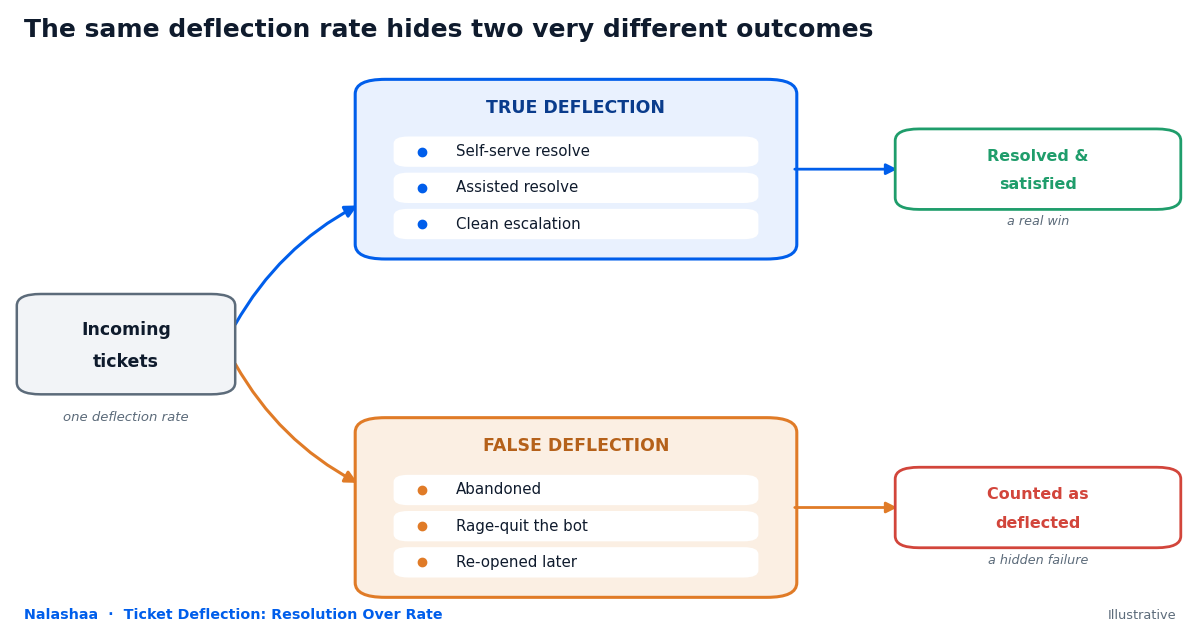
The table below shows how each outcome behaves once you look past the headline number.
| True deflection | False deflection | |
|---|---|---|
| What happened | Customer got their answer and left satisfied | Customer gave up, rage-quit, or opened a second ticket |
| Counts as deflected? | Yes | Yes, and that is the problem |
| CSAT effect | Neutral to positive | Negative |
| Re-contact rate | Low | High |
| Shows up as | Resolved, with no follow-up | A new ticket, a bad survey, or silence |
| What it really is | A win | A hidden support failure |
Once you separate the two, the job changes. You stop trying to push a single percentage higher and start trying to move as much volume as possible into the true-deflection column while keeping the false-deflection column small. That reframing is what turns deflection from a vanity exercise into a genuine improvement in how customers get help.
A deflected ticket that comes back was never deflected
The cleanest test of real deflection is whether the customer comes back. A ticket the bot supposedly resolved that reappears as a new contact within a few days was not deflected at all; it was delayed, and it cost you some trust on the way. Industry benchmarks put re-contact within 72 hours at roughly 11% on AI-resolved tickets against about 9% on human-resolved ones, so tracking re-contact is how you tell the genuine wins apart from the ones that only looked like wins on the dashboard.
What a good ticket deflection rate looks like in 2026
Once teams accept that resolution matters more than the headline rate, the natural next question is what a realistic number even looks like. The honest answer is that it depends heavily on your ticket mix, because some questions deflect easily and others almost never should.
Across enterprise support programs in 2026, median tier-one deflection sits around forty percent, with the strongest quartile reaching the high fifties. The averages hide a wide spread, though. Simple, well-defined intents like password resets and refund status deflect at seventy percent or more, because the answer is unambiguous and the bot can resolve it completely. Nuanced complaints and account-specific problems rarely break twenty-five percent, and pushing a bot to handle them anyway is how false deflection creeps in. A good deflection rate, then, is not a single target you chase across every ticket type. It is a high resolution rate on the questions that genuinely should deflect, paired with a clean, fast handoff on the ones that should not.
How to build ticket deflection that resolves instead of dodges
The gap between a deflection rate that helps customers and one that hides them comes down to engineering choices. A bot that reads from a stale FAQ and offers generic articles will inflate false deflection. A bot that answers the specific question and can act on it will earn true deflection. Five things separate the two.
Five things a deflection capability needs to resolve
- Real answers, not a FAQ dump. Ground the assistant in your live documentation and account data so it answers the specific question in front of it, rather than returning a list of articles the customer has to dig through.
- The ability to act, not just reply. Real resolution often means doing something, such as resetting a password or processing a refund, instead of explaining how the customer could do it themselves.
- Confidence thresholds. When the assistant is unsure, it should escalate rather than guess, because a confident wrong answer damages trust more than an honest handoff ever will.
- Clean escalation with context. When a question moves to a human, the full conversation should move with it, so the customer never has to start over and repeat themselves.
- An obvious human exit. A visible route to a person, available at any point in the conversation, is what makes customers comfortable trying self-service in the first place.
These are the same reliability concerns that apply to any production AI agent, which is why a support bot needs proper guardrails against wrong or off-policy answers. We cover that engineering in detail in our guide to building reliable AI agents with guardrails, and the principles there map directly onto a customer-facing support agent.
Make the human exit obvious
Hiding the path to a human does not raise your deflection rate; it raises your abandonment rate. When teams add a visible option to reach a person at any time, containment tends to hold steady while satisfaction rises, because customers trust a bot far more once they know they are not trapped inside it. An easy exit is not a leak in your deflection numbers. It is the thing that makes the deflection honest.
How to measure true resolution, not just deflection rate
If a single deflection number can hide an abandoned customer, then a single number is not enough to manage the program. The fix is to surround the deflection rate with a small panel of measures that, together, tell you whether customers were actually helped.
Four signals do most of the work. True-resolution rate tells you what share of deflected tickets ended with the customer's problem solved, rather than just routed away from an agent. Re-contact within seventy-two hours tells you how many of those resolutions did not hold. Post-bot CSAT tells you how the deflected customers felt about the experience. Clean-escalation rate tells you how often the handoffs that should happen actually happen smoothly. Read together, these four turn a vanity number into an honest one, because a high deflection rate now has to be backed by customers who came away satisfied and did not return. Measuring a deflection agent this way is the same discipline you would apply to any model in production, which we cover in our guide to LLM observability for multi-model pipelines.
How Nalashaa builds deflection that customers do not notice
The best deflection is the kind customers never think about, because the bot simply answered their question and they moved on with their day. Building that takes more than connecting a chatbot to a help center. It takes an assistant grounded in real data, the ability to act rather than just describe it, sensible confidence thresholds, clean escalation, and measurement that reports resolution instead of avoidance.
Nalashaa's AI engineering team builds support agents that answer from your live documentation and account data, take the action that closes the request, escalate cleanly when they should, and report true resolution rather than a flattering headline number. We build the agent, the guardrails that keep it honest, and the measurement that proves it worked, as one piece of work rather than three disconnected ones.
Want deflection that resolves, not deflection that hides the queue?
Nalashaa builds support agents that answer from your real docs and account data, take action to close the request, escalate cleanly when they should, and report true resolution instead of a vanity number. We build the agent, the guardrails, and the measurement together.
The bottom line on ticket deflection
A deflection rate stays a vanity metric until you can show that the deflected customer actually got helped. The number rises whether a customer found their answer or simply gave up, so on its own it tells you almost nothing about the quality of your support. Build for resolution rather than avoidance, ground the assistant in real data, let it act and not just talk, escalate the moment it should, and measure re-contact and CSAT alongside the headline rate. Do that, and the deflection number stops being something you defend in a review and becomes something you can trust, because behind it are customers who got what they came for.
Frequently Asked Questions
What is ticket deflection?
Ticket deflection is resolving a customer's question through self-service or an AI assistant so that it never needs a human agent. Done well, it saves cost and time and done badly, it simply hides unresolved tickets behind a flattering number.
What is a good ticket deflection rate?
In 2026, median tier-one deflection sits around forty percent, with simple intents like password resets and refunds deflecting at seventy percent or more and complex complaints rarely breaking twenty-five percent. A good rate depends on your ticket mix, and resolution matters far more than the headline figure.
How is the deflection rate different from the resolution rate?
Deflection rate counts every ticket that did not reach an agent, including the ones where the customer gave up. Resolution rate counts only the tickets where the customer actually got their problem solved, which is the number that reflects real support quality.
Can ticket deflection hurt customer satisfaction?
Yes, when deflection traps customers instead of helping them. A bot that frustrates people into leaving raises the deflection number while CSAT and re-contact rates quietly get worse, which is how a rising rate can sit next to a falling satisfaction score.
What is false deflection?
False deflection is a ticket counted as deflected because it never reached an agent, even though the customer abandoned the bot, rage-quit, or opened a second ticket. It looks like a win in the metric and is a failure in reality.
How do you measure ticket deflection honestly?
Track true-resolution rate, re-contact within seventy-two hours, and post-bot CSAT alongside the deflection rate, so that a high number has to be backed by customers who got helped rather than customers who simply left.