Quick Evaluation Before You Dine In:
Before you read the use cases below, take a minute.
If you're trying to figure out where automation fits your team, scan this list.
Are lawyers spending time on repeatable drafting or review steps?
Are approvals tracked manually across emails and spreadsheets?
Do contracts get signed but obligations aren’t consistently tracked?
Is compliance work dependent on reminders and manual monitoring?
Are high volumes of documents reviewed the same way every time?
Do business teams ask legal the same policy questions repeatedly?
If even a few of these feel familiar, you likely already know where to begin.
Now scroll down and match your friction point with the use case that fits it.
I will be honest. When it comes to legal work, I was skeptical too.
Not skeptical about technology in general, but skeptical about how far automation in legal industry workflows could really go without creating risk. Legal work depends on context, precision, and accountability. So for a long time, the AI conversation felt louder than the reality.
What changed my perspective was seeing where automation actually works and where it should not. The real opportunity is not replacing legal judgment. It is reducing the operational drag around it. When routine work like document handling, compliance checks, intake, tracking, reporting, and repetitive administrative steps are automated, legal professionals get more time for strategy, advisory work, and client outcomes. That is where ai and automation in legal industry settings starts to make practical sense.
This is also where many firms are now shifting their focus. The conversation is no longer just about whether there should be automation in the legal industry. It is about how to apply it responsibly, where to begin, and how to create measurable results without compromising quality.
The Modern Legal Automation Stack
Legal automation today is not a single tool. It is a layered stack of technologies designed to remove operational friction across intake, documents, systems, and decision workflows. Most failures in legal automation do not come from the AI model itself. They come from poor workflow design, weak integrations, lack of governance, or skipping adoption planning. A stack approach addresses these gaps by connecting specialized components into one controlled system.
At a high level, the modern legal automation stack includes the following layers.
Workflow and routing layer
This layer manages intake forms, dynamic approval paths, SLA timers, escalations, and evidence logging. Instead of work being tracked in emails or memory, every request is routed, timed, and recorded. This becomes the operational backbone of legal teams that handle high request volumes.
RPA execution layer
Robotic process automation handles repetitive actions across legacy systems, third-party portals, and internal tools. Bots can enter data into HR or ERP systems, monitor shared inboxes, pull documents from portals, update matter records, and reconcile information across systems. This layer is critical for legal teams operating in fragmented environments.
Document understanding and IDP layer
Intelligent document processing combines OCR, machine learning classification, and data extraction to process contracts, filings, forms, and scanned records. Because legal work is document-heavy, this layer often unlocks the majority of automation value by converting unstructured documents into usable data for workflows and review.
AI and GenAI layer
AI supports summarization, clause analysis, playbook matching, drafting assistance, and knowledge retrieval using structured and RAG-based approaches. Outputs are designed for review, not automatic execution. In practice, AI speeds up legal work but still requires lawyer verification to maintain accuracy and defensibility.
Governance and security layer
This layer ensures the stack operates within regulatory and organizational controls. It includes data residency management, model access controls, prompt and output logging, PII masking, audit trails, and bias checks. Governance is what makes automation acceptable in regulated legal environments.
Human-in-the-Loop Architecture
A defining pattern across modern legal automation deployments is human-in-the-loop design. Automation handles preparation, routing, and data processing, but key legal decisions remain with lawyers. For example, AI drafts a response, a lawyer approves it, and an RPA bot files or records it. This attended automation model reduces operational errors while preserving professional judgment and accountability.
Where RPA and AI Create the Most Value in Legal Workflows
Legal teams see the strongest return from automation where three conditions exist: high volume work, stable rules, and expensive human attention tied up in repeatable steps. When those conditions align, RPA, generative AI, and now agentic AI do not replace lawyers. They remove operational drag so legal professionals can focus on judgment, strategy, and client relationships.
Below are the areas where teams are already seeing measurable impact and where automation can realistically be introduced.
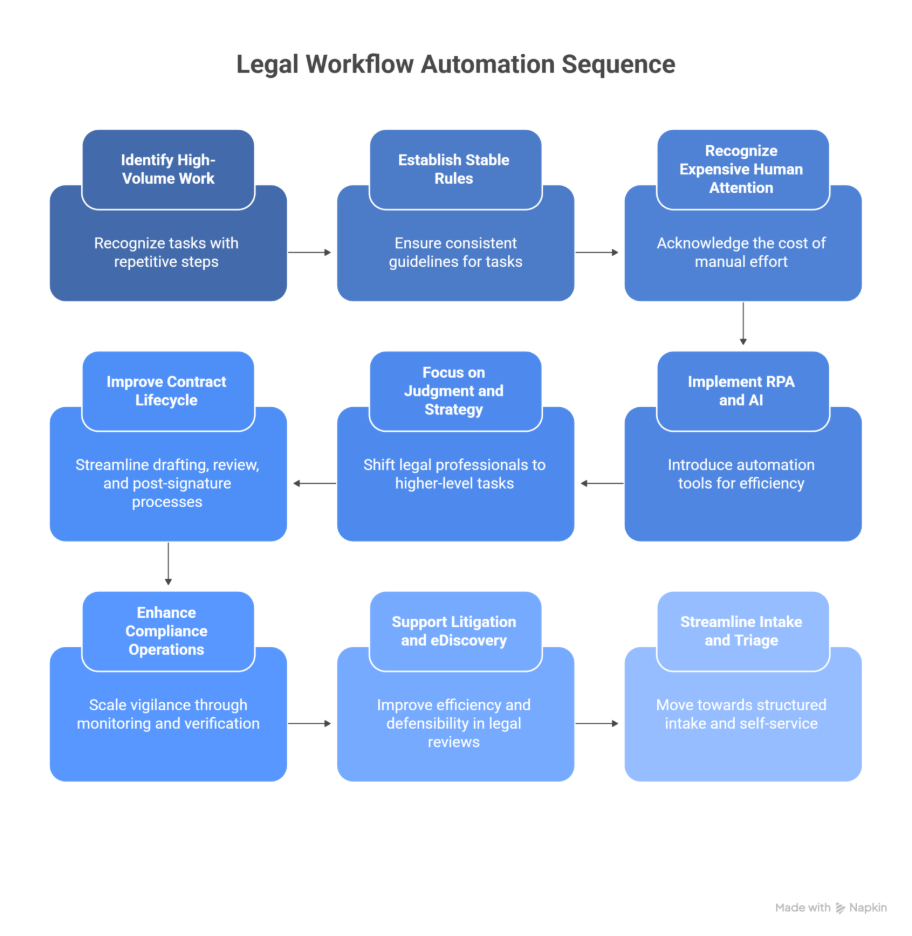
Contract lifecycle work that reduces effort and leakage
Contracting is one of the most automation-ready legal domains because it combines repeatable drafting, structured data, and downstream operational impact. Research consistently points to contract management as a source of commercial leakage. Some estimates place average value loss near 9 percent annually, though results vary by maturity. More recent analysis highlights the post-signature “handover gap,” where obligations fail to reach finance, procurement, or delivery teams on time.
RPA and AI create value across the lifecycle.
Pre-signature
- Template-driven drafting and clause governance improve consistency
- Automated redlining surfaces deviations from standard language
- Non-standard terms are extracted and escalated for review
Review
- AI-assisted clause extraction and issue spotting speed up first-pass review
- Benchmark studies show AI reviewing NDAs achieving higher accuracy than cohorts of experienced lawyers and completing work in seconds rather than hours
- Standardized agreements benefit most from first-pass automation
Post-signature
- Obligation tracking and renewal alerts reduce missed commitments
- Contract data syncs into procurement and finance systems
- RPA handles updates across fragmented systems and portals
Compliance operations that scale vigilance
Compliance work is continuous and document heavy. Much of it involves monitoring changes, assembling evidence, and sending repetitive communications. This makes it well suited to RPA combined with AI.
Monitoring and notification
- Robots monitor regulatory updates, sanctions lists, and policy changes
- Automated alerts trigger workflows so legal teams focus on interpretation rather than tracking updates
Screening and verification
- Counterparty checks against sanctions or restricted party lists
- Export control and regulatory validation
- Notifications triggered only when issues require legal review
Evidence and audit trail creation
- Automatic logging of actions and decisions
- Encrypted records and traceable workflows
- Audit-ready documentation for regulators
Litigation support and eDiscovery that remains defensible
eDiscovery has long been a domain of human and machine collaboration. Technology-assisted review can be more effective and efficient than exhaustive manual review when implemented correctly. Courts and professional bodies continue to publish guidance supporting structured use of these tools.
Where automation fits best:
- Data ingestion, deduplication, and classification
- Sampling and validation workflows
- Privilege review support
- Logging and defensible audit trails
Intake, triage, and legal self-service
Many legal teams are moving away from unstructured email requests toward guided intake and structured workflows. This shift improves both efficiency and the experience of working with legal.
Where value appears quickly:
- Structured intake forms replace scattered requests
- Automated routing and SLA tracking improve visibility
- AI-supported answers handle common policy questions
- Faster turnaround for routine matters
Key Takeaways
Automation can return massive time capacity fast
Legal teams have reported 10,000 hours saved in just 6 months through RPA-led automation of repetitive workflows.
That level of time recovery can be the equivalent of adding double-digit full-time capacity without increasing headcount.
Manual error rates can drop significantly
Firms using automation in legal workflows have seen up to 25% fewer contract-related errors.
This is especially valuable in high-volume work where small mistakes lead to rework, delays, or compliance risk.
Case handling can move faster
Automating case tracking and routine process steps has helped teams achieve up to 20% faster case resolution.
Faster turnaround improves both internal productivity and client experience.
Compliance operations can become more cost-efficient
RPA and AI-assisted monitoring have helped reduce compliance-related costs by around 20%.
The savings come from less manual review time, fewer missed checks, and better process consistency.
High-volume legal admin work is one of the easiest wins
Repetitive tasks like data entry, invoice processing, document routing, and reporting are ideal for early automation.
These are typically rules-based, time-consuming, and easy to standardize.
AI makes automation useful beyond simple task clicking
When AI is combined with RPA, teams can automate work that involves document reading, information extraction, and basic decision support.
This expands automation from back-office admin into more meaningful legal operations support.
Accuracy + speed is the real business case
The biggest gains are not just “doing tasks faster,” but doing them faster with fewer mistakes.
That combination improves throughput, reduces rework, and creates more predictable operations.
Lawyers can spend more time on billable and strategic work
Automation shifts effort away from repetitive processing and toward advisory work, negotiations, risk analysis, and client communication.
You do not need to automate everything to see results
Even targeted automation of a few repetitive workflows can produce measurable gains in time saved, cost reduction, and error prevention.
The results are practical, not experimental
The reported outcomes show that legal automation is already delivering operational impact, not just future potential.
Conclusion
Firms introducing AI and automation in legal operations commonly see measurable gains within the first year. Teams recover 15 to 30 percent of time spent on repetitive admin and review work, contract first-pass reviews move 50 percent faster, and compliance monitoring costs can drop by around 20 percent through automation. Billing accuracy also improves as missed time and manual tracking errors reduce.
However, automation in legal industry environments works best when implemented responsibly, with governance, security, and human oversight built in from day one. The opportunity is not just efficiency. It is sustainable growth, better client service, and stronger operational control.
If you are evaluating where automation fits in your legal practice, get in touch with our experts to assess your current workflows and identify practical, high-impact starting points tailored to your firm.