
A tester opens a new sprint with a hundred test cases to write, a pile of defect reports to summarize, and a backlog of edge cases nobody has had time to cover. Generative AI looks like the obvious answer, and in part it is. It drafts the hundred cases in minutes and clusters the defects while you read the first one.
The question worth asking is not whether generative AI will transform testing, because that framing sends teams looking for a revolution and leaves them disappointed when they get a productivity tool instead. The better question is narrower and more useful.
Where does generative AI genuinely speed up quality assurance, where does it quietly cost you time and quality, and how do you fold it into a QA process without giving up the thing you are there to protect? This article maps all three.
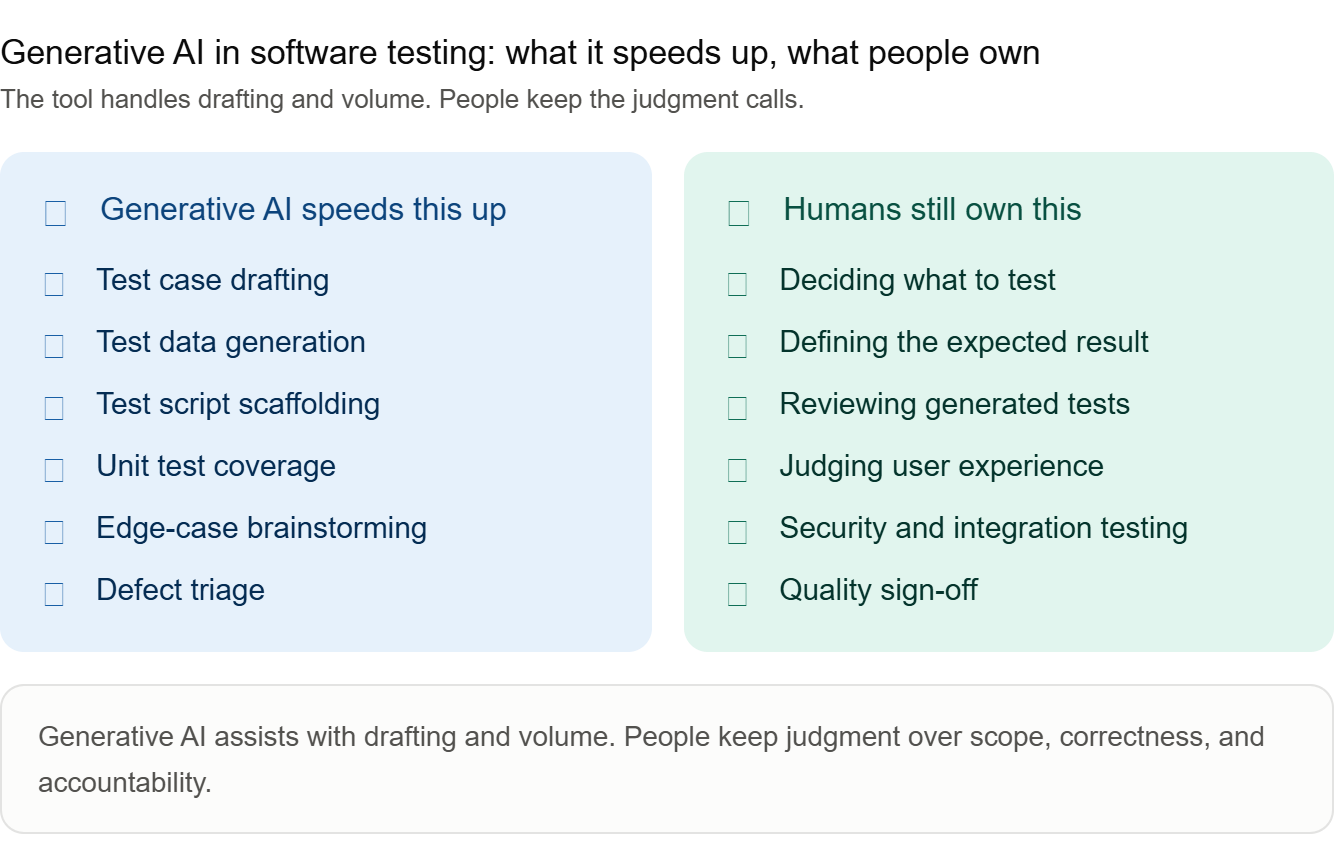
Generative AI produces testing material faster: test cases, test data, scripts, edge cases, and defect summaries. But it cannot decide what to test, cannot reliably know the correct outcome, and cannot have accountability for quality. The technology assists testers with volume and speed. It does not replace their judgment. Knowing where it helps before you roll it out is most of the battle.
What Generative AI Does in Software Testing
Generative AI produces new artifacts from a prompt and the context you give it. In testing that means test cases, test data, automation scripts, unit tests, and written summaries of defects. This is a different capability from test automation, which executes tests that already exist. It helps you create the material, and automation runs it. Most teams end up using both together, and confusing the two is the first mistake to avoid.
The limit to understand before you start is that the model predicts plausible output rather than correct output. It generates what testing material usually looks like for a prompt of this shape, drawn from patterns across its training, and that is not the same as knowing how your system is supposed to behave. Ask it to generate a dozen test cases for a checkout flow and you will get roughly twelve reasonable-looking cases. Nine of them are usable as written, two are brittle in ways you will only notice on the second read, and one asserts the wrong total because the model guessed at the tax rule your product implements. That mix is the reality of working with generated tests, and it explains why the review step is not optional.
The pattern is not unique to testing. MIT's Project NANDA, in its 2025 GenAI Divide study, found that roughly 95 percent of enterprise generative AI pilots produced no measurable profit and loss impact, and the researchers traced the failure to how the tools were folded into real workflows rather than to the quality of the models themselves. Testing is one of the places that lesson lands hardest, because a tool that produces plausible material at speed can create the feeling of progress while the quality signal underneath stays flat.
Where Generative AI Speeds Up QA
Generative AI earns its place in a QA process on the tasks that are high in volume, repetitive, and slow to start from a blank page. On these, it removes the friction of the first draft and hands the tester something to react to, which is faster than creating from nothing.
Drafting test cases
Writing test cases from a requirement or a user story is work that starts slowly and then speeds up once the pattern is clear. Generative AI collapses the slow part. Give it the requirement and it returns a structured set of cases in seconds, covering the obvious paths and several you might reach eventually. The tester then edits, removes duplicates, and adds the cases the model missed, which is quicker than opening an empty template.
Generating test data
Realistic, varied test data is tedious to produce by hand, and teams often under-test because they reuse the same three records. Generative AI produces synthetic data across a wide range of shapes, including the awkward values that expose bugs: empty fields, unusual characters, boundary numbers, and malformed inputs. This is one of the safest places to start, because the cost of a weak record is low, and the benefit of broad coverage is high.
Scaffolding test scripts
Automation scripts carry a lot of boilerplate before they carry any logic. Generative AI writes the scaffolding fast: the setup, the teardown, the standard assertions, and the structure your framework expects, so engineers spend their time on the parts that need thought rather than on the parts that need typing. The generated script is a starting point that a person then makes correct, not a finished asset.
Filling unit test coverage
When a codebase has gaps in unit test coverage, generative AI drafts tests for the obvious paths quickly and closes the easy gaps that nobody got around to. It will not reason about the subtle failure modes on its own, but clearing the routine coverage frees engineers to write the harder tests that need real understanding of the code.
Brainstorming exploratory ideas
Exploratory testing rewards imagination, and even strong testers work from habit. Asked for edge cases on a feature, generative AI suggests angles a tester may not have considered, unusual sequences, rare combinations, and inputs that sit outside the happy path. Not every suggestion is worth pursuing, and the value is in the prompt to think wider, not in the list itself.
Handling defect noise
A busy defect queue is full of duplicates, thin reports, and inconsistent reproduction steps. Generative AI summarizes long threads, clusters related reports, and drafts cleaner reproduction steps, which cuts the manual triage that eats a QA lead's morning. A person still confirms the clustering and owns the priority call, but the first pass arrives already organized.
The pattern across all six is the same. Generative AI removes the slow first step and lets the tester spend their attention on judgment instead of on production. That is a real gain, and it is worth having.
Where Generative AI Does Not Step Up
The same tool that drafts a hundred cases in a minute fails on the parts of testing that decide whether the product is any good. These are the parts that need judgment, and judgment is exactly what a predictive model does not have.
It does not know what to test
Deciding what to test is a judgment about risk, business impact, and how real users behave. It depends on knowing which parts of the product carry the most consequence when they break, which customer workflows matter most, and where past defects clustered. A model has none of that context unless you supply it, and even then it cannot weigh the factors the way a tester who knows the product can. What to test is the most important decision in QA, and it stays with people.
It struggles with the expected result
This is the hardest limit and the one teams underestimate most. A test is only meaningful if it checks against the correct expected result, and the model cannot reliably know what the correct result is for your system. It knows what a plausible result looks like. When it guesses the expected value and gets it wrong, you get a test that passes confidently while asserting the wrong thing, which is more dangerous than no test at all because it manufactures false confidence.
It produces tests that need real review
Generated tests are frequently brittle, tied to specific wording or a fixed order that breaks the moment the interface changes. Some are shallow, checking that something happened without checking that the right thing happened. Others are flaky and pass or fail without a code change. Left unreviewed, these tests turn into a maintenance burden that erases the time the generation saved, and the team ends up slower than before.
It cannot judge experience
Whether an error message is clear, whether a flow feels right, and whether a screen is usable are human judgments about experience. A model can flag that an error message exists. It cannot tell you the message will confuse a first-time user or that the flow asks for information in an order that frustrates people. That evaluation needs a person.
It is weak on the hard cases
Complex integrations, security testing, and non-deterministic behavior are where generated tests are least trustworthy. These cases need reasoning about how systems interact, where an attacker would probe, and why a result varies between runs. This is precisely the territory the industry now recognizes as its own discipline. ISTQB's Certified Tester in Testing with Generative AI syllabus, approved in 2025, exists because testing AI-driven and non-deterministic systems responsibly takes structured skill rather than a good prompt.
It cannot be held accountable
When an auditor, a regulator, or a customer asks who signed off on quality, the answer has to be a person. A model cannot carry accountability, cannot stake professional judgment on a release, and cannot answer for a defect that reached production. Quality ownership is a human responsibility, and that does not change because the first draft of a test was machine-generated.
How to Use It Without Losing Quality
The teams that get value from generative AI in testing treat it as a fast assistant working under a skilled tester's direction. Five practices keep the speed without giving up the quality.
Treat every output as a first draft
Nothing the model produces enters the test suite until a tester has reviewed it. That review is the control that catches the brittle case, the wrong expected result, and the shallow assertion before they cost you in production. Build the review step into the workflow rather than leaving it to discipline under deadline pressure.
Keep humans on the two hardest calls
Deciding what to test and defining the correct expected result stay with people, without exception. These are the two decisions that determine whether testing means anything, and they are the two the model is least equipped to make. Let it draft around those decisions, never make them.
Start where it is safe
Introduce generative AI first on the low-risk, high-volume work: test data, script boilerplate, routine unit tests, and defect summaries. You get an immediate return with little exposure, the team builds judgment about where the output is trustworthy, and you avoid betting quality on the tasks the model handles worst. This mirrors the evaluation-readiness discipline that any AI feature deserves before it reaches production, applied to your own QA process.
Keep your engineering discipline
Generated material stays honest only inside a solid framework, with review gates, coverage standards, and the same engineering discipline you would apply to any code. The tooling does not lower the bar for structure. If anything it raises it, because a fast source of plausible tests needs a strong filter to stay useful.
Measure quality, not just speed
The trap is to measure how many tests you produced and how fast, because those numbers always look good with generative AI in the loop. Measure the signals that matter instead: escaped defects, test flakiness, and real coverage of meaningful behavior. If those hold or improve while output rises, the tool is working. If they slip, you are generating volume, not quality, and the speed is an illusion.
Will AI Replace QA Testers?
No. Generative AI is strong at drafting and weak at judgment, and testing is a judgment discipline with a drafting component, not the other way around. What changes is the shape of the work. Testers spend less time typing boilerplate and writing routine cases, and more time on the parts that carry value: deciding what to test, defining correctness, exploratory testing, security, and user experience. The role moves up the value chain rather than disappearing. The teams that thrive treat generative AI as a fast assistant that a skilled tester directs, and they invest in the judgment that direction requires.
Where to Go From Here
If you want to bring generative AI into your QA process without giving up quality, the work is in the judgment: choosing where it helps, keeping people on what to test and what the right answer is, and holding your engineering discipline steady while you do it. That is what our software testing and QA automation team does with product teams every day, and generative AI is the next layer we are building on that discipline.
Tell us where your QA is slowest today, and we will help you find where generative AI pays off and where it does not.
Frequently Asked Questions
What is generative AI in software testing?
Generative AI produces testing artifacts, such as test cases, test data, scripts, and defect summaries, from a prompt and the context you provide. It differs from test automation, which runs predefined tests rather than creating new material. In practice teams use the two together, with generative AI creating material and automation executing it.
Where does generative AI speed up testing?
It is fastest on high-volume, repetitive work: drafting test cases from requirements, generating varied test data, scaffolding automation scripts, drafting unit tests for obvious paths, brainstorming edge cases, and summarizing and triaging defects. On these tasks it removes the slow first draft and lets testers spend their attention on judgment.
Where does generative AI fall short in testing?
It cannot decide what to test, because that is a judgment about risk and business impact. It cannot reliably know the correct expected result, it produces tests that need careful review for brittleness and flakiness, it cannot judge user experience, and it cannot own accountability for quality when someone asks who signed off.
Will AI replace QA testers?
No. It shifts testers toward judgment, risk, correctness, and higher-value exploratory and experience testing while it handles the repetitive first drafts. The role changes rather than disappears, and the testers who direct the tool well become more valuable, not less.
Is generative AI the same as test automation?
No. Automation executes predefined tests and tells you whether they pass. Generative AI helps create the tests, data, and documentation that go into them. They solve different problems, and most mature QA teams run both, using generation to produce material and automation to run it at scale.
How do you use generative AI in testing safely?
Treat every output as a first draft that a tester reviews before it enters the suite, keep people on the two hardest calls of what to test and what the correct result is, start with low-risk high-volume tasks, hold your framework and review gates steady, and measure quality signals such as escaped defects and flakiness rather than raw output.