
Software Product
Engineering Solutions
End-to-end product engineering, accelerated with AI, delivered by teams accountable for what runs in production.
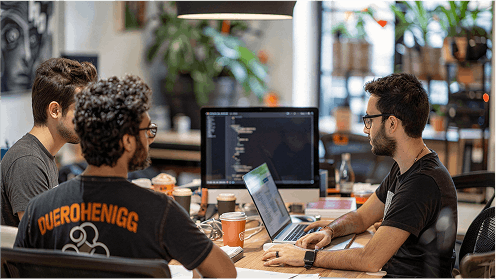
Product Engineering Services Across the Lifecycle
Built to support products at every stage, from early decisions to long-term scale.
Web Application Development
Design and build scalable web applications that support real-world usage, performance demands, and long-term evolution.
Mobile Application Development
Develop mobile applications focused on reliability, usability, and seamless integration with backend systems.
UI/UX Solutions
Create intuitive product experiences and design systems that support adoption, consistency, and future enhancements.
Quality Assurance
Embed quality across the product lifecycle through structured testing, automation, and release validation.
Mobile App Maintenance
Keep published iOS and Android apps compliant, stable, and shipping with SLA-backed maintenance and support.
Legacy Migration
Modernize legacy applications while preserving core functionality, data integrity, and business continuity.
API Management
Design and manage APIs that enable integration, extensibility, and platform scalability.
DevOps Services
Enable predictable releases through CI/CD pipelines, infrastructure automation, and environment standardization.
Cloud Solutions
Build and modernize cloud-based architectures designed for resilience, security, and scale.
Business Intelligence
Enable product and business teams to make informed decisions using reliable, well-modeled analytics.
Data Services
Prepare and manage product data to support reporting, integrations, and future AI readiness.
AI Strategy Consulting Services
Define practical AI opportunities, align AI investments to product goals, and prepare data and architecture so AI enhances product value without creating risk.
Product Engineering vs Platform Engineering
Building the product experience itself � features, performance, and interfaces that users interact with directly.
Building and maintaining the foundations that support product delivery
Why both are required?
Product engineering drives what users see and experience. Platform engineering ensures those experiences can be delivered repeatedly, reliably, and at scale. Sustainable product engineering requires both to evolve together as products mature and complexity increases.
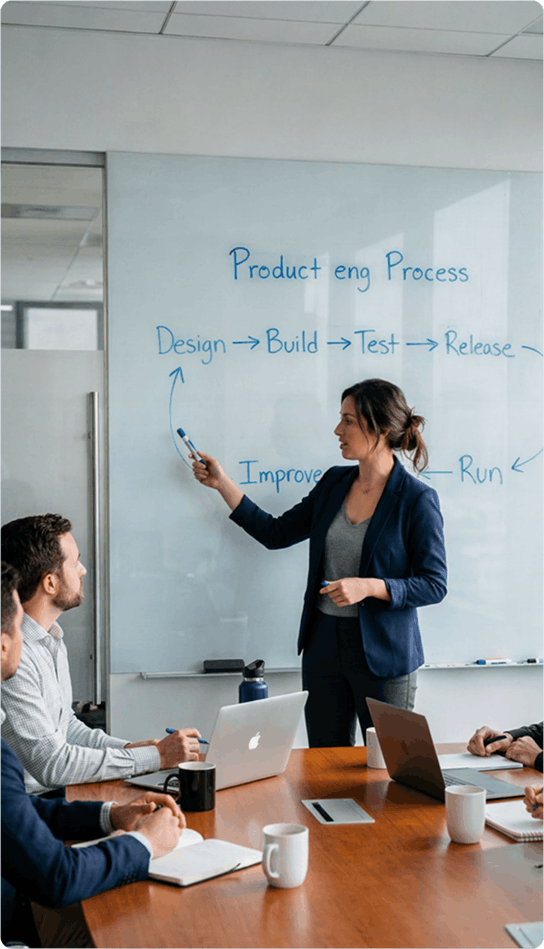
How Product Engineering Progresses
Every product moves through distinct engineering stages as it scales, matures, and meets real operational constraints.
Discover and Align
Engineering begins by aligning product goals with technical realities before key decisions are made.
- Define product scope and objectives
- Understand user expectations and constraints
- Identify architectural risks
- Set quality, security, and scalability expectations
Build and Evolve
With alignment in place, teams expand capabilities while maintaining performance and stability.
- Deliver features while maintaining performance and maintainability
- Support integrations with other systems
- Refactor code and modernize components incrementally
- Adapt architecture for new use cases without breaking functionality
Release with Confidence
Releases require structured validation to maintain reliability as systems grow more complex.
- Conduct quality and performance testing
- Validate security and system stability
- Use release engineering and deployment pipelines
- Maintain predictable and controlled release cycles
Run and Improve
Engineering work continues after launch to maintain product resilience and long-term performance.
- Monitor product performance and reliability
- Perform maintenance and system improvements
- Address technical debt
- Strengthen stability and adaptability over time
Applying AI in Product Engineering
A measured, strategic approach to AI adoption in software development
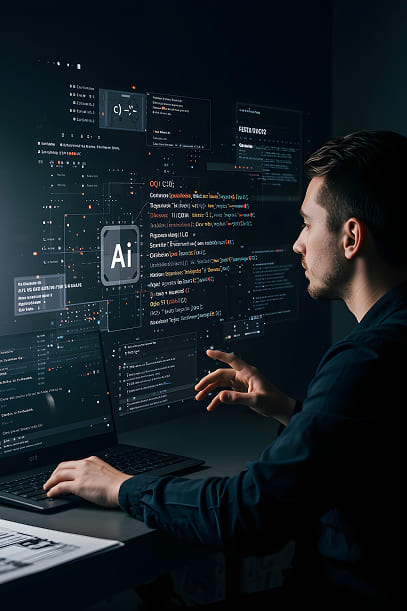
Strategic AI Integration
AI can speed up parts of the product engineering process, but it is not applied blindly. We use AI where it clearly improves efficiency or quality and avoid it where it introduces unnecessary risk.
Accelerating Early Stages
In early and iterative stages, AI supports code analysis, test generation, documentation, and data exploration. These accelerators help teams move faster while maintaining engineering standards.
Mission-Critical Rigor
For mission-critical systems, regulated environments, and core transaction workflows, traditional engineering practices remain essential. Predictability, auditability, and system reliability take priority.
Balanced Approach
This approach allows teams to benefit from AI without compromising stability, security, or long-term maintainability.
Accountability Proven in Real Projects


Why Teams Partner with Nalashaa

Predictable Delivery Across the Product Lifecycle
Product engineering programs run on agreed milestones, release plans, and priorities. We stay aligned to delivery commitments as products evolve, so progress remains visible and predictable.
Engineering Decisions Made Right, Early
Architecture, design, and technology choices are made with long-term product impact in mind. This reduces rework, avoids fragile builds, and prevents technical debt from becoming a growth blocker later.
Security Considered as Part of the Product
Security is treated as a core engineering concern, not an afterthought. Data handling, access control, and system integrity are accounted for as products are built, modernized, and scaled.
Performance Designed to Grow with Usage
Products are engineered to support increasing users, data volumes, and integrations. Performance and reliability are addressed before the scale exposes weaknesses.
Systems That Can Adapt as Requirements Change
Products rarely stay static. We design systems that can absorb new features, integrations, and business changes without forcing large redesigns or disruptive rewrites.
Support your digital transformation with the right engineering partner
We combine domain expertise and product engineering to support your current needs, unlock new opportunities, and help you create real business value.
Frequently Asked Questions
Software product engineering solutions cover the end-to-end process of designing, building, modernizing, and supporting software products. This includes architecture, development, quality, platform readiness, and sustained engineering to ensure products remain reliable and scalable over time.
Custom software development typically focuses on delivering a defined application or feature set. Product engineering takes a broader, long-term view, supporting products across their lifecycle with attention to roadmap evolution, platform stability, scalability, and ongoing improvement.
We work across both. Many engagements involve modernizing or extending existing products while keeping business operations running. New product builds are supported as well, especially when long-term scale and maintainability are priorities.
Modernization is handled incrementally. Core functionality, data integrity, and user workflows are preserved while architecture, performance, and experience are improved in phases to minimize risk and disruption.
AI is used selectively to accelerate activities such as analysis, testing, and documentation. For mission-critical or regulated systems, traditional engineering practices remain the foundation to ensure predictability, security, and auditability.
Post-launch support includes application maintenance, performance optimization, technical debt management, and ongoing enhancements. This ensures products remain stable and adaptable as requirements evolve.
We work with SaaS providers, enterprise product teams, and organizations operating business-critical platforms where reliability, scalability, and predictable delivery are essential.
Engagements typically begin with a focused discovery phase to align goals, constraints, and priorities. From there, we define the delivery approach and team structure based on the product’s stage and complexity.