
Reader's Note
A buy-versus-build cost guide for engineering leaders deciding whether to run open models in-house or call a cloud API. No vendor pitch, just the math, including the cases where self-hosting loses.
When we search for self-hosted LLMs, one of the first results asks whether the whole idea is pointless. The result right below it explains how to run a model on a gaming laptop. Both skip the question an engineering leader has: at our request volume, with our data rules, will running this ourselves cost less than paying a cloud API, and if it does, at what point?
That question has a real answer, but you cannot reach it from a GPU sticker price or a per-token rate card. A self-hosted LLM can run at a fraction of the cost of a cloud API. The same deployment, sized slightly wrong or left half-idle, can cost several times more. The deciding factors are how hard you push the hardware, how much you send through it, how fast you need answers back, and where your data is legally allowed to live. This guide walks each one and gives you a break-even model you can hold up against your own numbers.
"Local LLM" and "self-hosted LLM" describe two different cost problems
Before any math, separate two terms that search engines treat as cousins and finance teams should treat as strangers.
When people search to run an LLM locally or set up a local LLM, they usually mean one machine. A developer installs Ollama or LM Studio, pulls a quantized model, and runs prompts against their own laptop or workstation. It costs nothing beyond hardware they already own, and it is excellent for prototyping, private experiments, and learning what open models can do. It is also not a product you can put in front of customers. One machine gives you no concurrency, no uptime guarantee, and no way to scale when traffic spikes.
A self-hosted LLM (or private LLM, or self-hosted AI deployment) means something heavier. You run the model on infrastructure you control, size it for real traffic, keep it available, and serve many users at once. That is a production system with production costs. Everything below addresses this second case, because that is where the buy-versus-build decision carries real money.
What it Costs to Self-Host an LLM
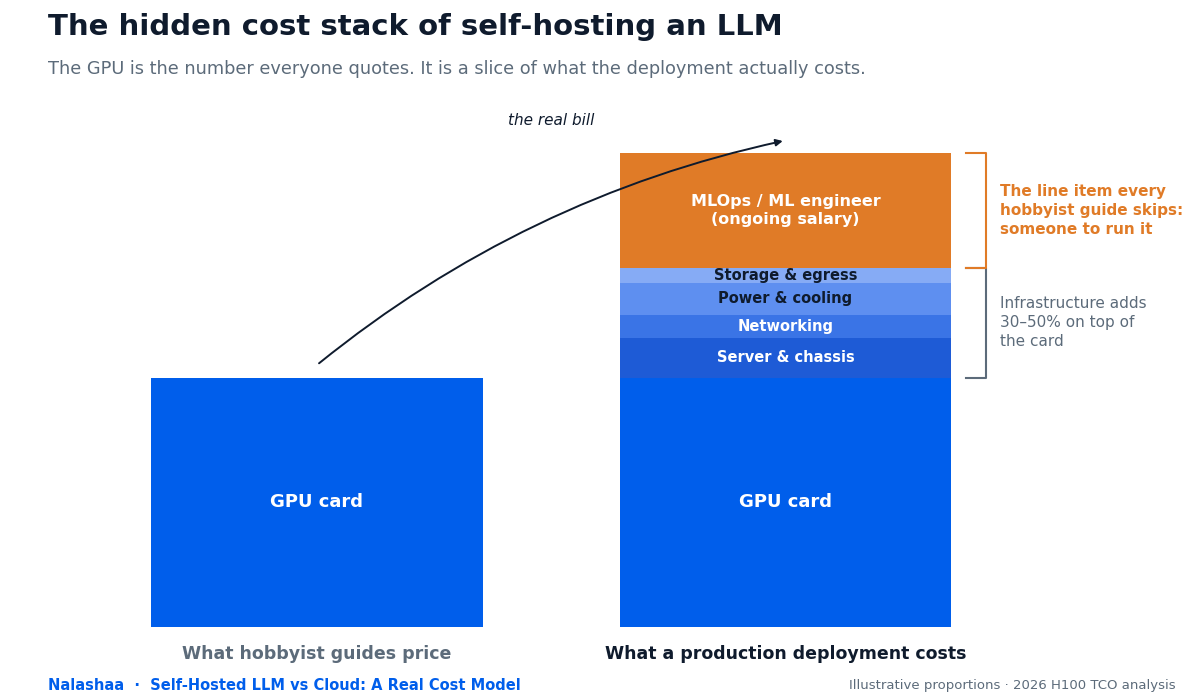
Most cost guides price the GPU and stop. The GPU is the part everyone quotes because it is the easiest number to find. It is also a minority of the bill.
Start with the chip itself. An NVIDIA H100, the workhorse for serious inference in 2026, costs between $25,000 and $40,000 to buy outright, depending on the PCIe or SXM variant and the vendor. A single 8-GPU server runs from roughly $200,000 to over $350,000. If you rent the same card from a cloud GPU provider instead, the open market sits around $2 to $4 per GPU-hour, with specialized providers dipping under $2 and hyperscaler's charging $7 and up.
$25,000 to $40,000
The price of a single NVIDIA H100 GPU to buy in 2026. An 8-GPU server runs $200,000 to $350,000 and up. Renting the same card costs roughly $2 to $4 per GPU-hour on the open market.
Sources: CloudZero and getdeploying H100 pricing trackers, 2026.
Now add what the GPU needs around it to do useful work. A purchased H100 has to live in a server chassis with fast networking, redundant power, and cooling built to handle a card that draws serious wattage. Industry pricing puts a complete production setup at 30 to 50 percent above the bare card price before you serve a single token. Then there is storage for model weights and logs, plus egress charges every time data leaves your environment, which run eight to twelve cents per gigabyte on hyperscale clouds.
The line item that surprises teams most is people. A production inference cluster needs someone who can keep it alive: an MLOps or ML platform engineer who handles model updates, monitors throughput, fixes the cluster at 3 a.m. when it stops responding, and tunes it as traffic grows. Cloud APIs fold that work into the price you pay. Self-hosting puts it back on your payroll.
The hidden cost stack
The GPU is the cheapest expensive thing you will buy. Beneath it sit the server, the networking, the power draw, the cooling, the storage, the egress, and at least one engineer who knows how to run inference in production. Hobbyist guides price the card and call it a day. Production teams price the whole stack, and the stack typically adds 30 to 50 percent on top of the card before the first request lands.
There is one more cost that hides in plain sight: idle time. A GPU you bought is only cheap per request if it stays busy. Run it at 30 percent utilization and your effective cost per token roughly triples, because you are paying for the other 70 percent of the time it sits warm and waiting. Utilization is the single biggest lever in the entire model, and it is the one teams control least well in the first year.
What it costs to run an LLM on a cloud API
A cloud API inverts every cost above. You pay per token, the provider owns the hardware, and you carry close to zero operational overhead. Spin-up takes minutes, scaling happens on its own, and the bill stays near zero until usage climbs.
That structure makes the cloud the right answer for most teams below a certain volume. You skip the capital outlay, you skip the hiring, and you pay only for what you use. Frontier API prices have also fallen steadily, which keeps the option attractive even as your traffic grows.
The cost behaves differently as you scale, though. Per-token pricing is linear: every request adds to the bill, and the bill never stops. A workload that costs $400 a month at launch can cost $14,000 a month once a feature ships to your full user base, and it will keep costing that every month afterward. Heavy users also run into surcharges the rate card does not advertise: data egress, rate-limit tiers, and premiums for fine-tuning or dedicated capacity. None of this makes the cloud wrong. It means the cloud trades a low entry cost for a meter that runs forever.
The break-even point: where self-hosting starts costing less than the cloud
Here is the comparison most teams want, side by side.
| Cost line | Self-hosted LLM | Cloud LLM API |
|---|---|---|
| Compute | GPU you rent or buy and size yourself | Per token, metered |
| Infrastructure | Server, network, power, cooling | None, the provider owns it |
| People | MLOps or ML engineer required | Minimal |
| Idle risk | You pay for unused capacity | You pay only for use |
| Scaling | You provision ahead of demand | Elastic and instant |
| Data residency | Full control, can stay on premise | Depends on the provider |
| Model upgrades | You migrate them | The provider ships them |
| Cost at low volume | High, fixed costs dominate | Low |
| Cost at high sustained volume | Low per request | High, it compounds |
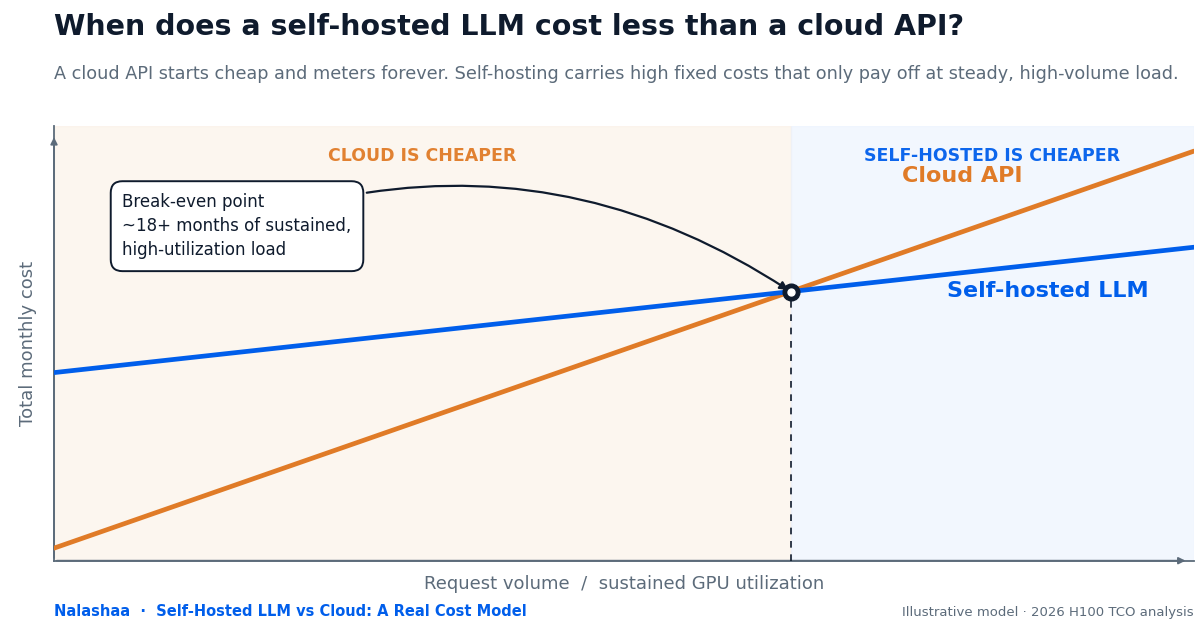
The crossover follows from the table. At low volume, the cloud wins easily, because the self-hosted side carries fixed costs that a handful of requests cannot absorb. As volume rises, the cloud meter keeps climbing while the self-hosted cost per request keeps falling, since you are spreading the same fixed cost across more work. Somewhere in the middle, the two lines cross. To the left of that point the cloud is cheaper. To the right, self-hosting is.
The naive version of this math is where most guides stop, and it is wrong. Take a $25,000 GPU against a $3-per-hour cloud rate and you get a break-even near 8,300 hours, about 347 days of running the card around the clock. Clean number, wrong answer. It assumes the GPU is your only cost and that it runs at full tilt every hour. Neither holds. Fold in the server, power, cooling, and networking the card needs, then account for real-world utilization well below 100 percent, and the true crossover moves out to 18 months or more of continuous, near-saturated load.
18+ months
Of continuous, near-full GPU utilization before a purchased H100 server actually beats cloud rental, once you include the infrastructure the card needs and the idle hours it will inevitably sit through. The naive math says a year. Reality says longer.
Source: CloudZero unit-economics analysis, 2026.
Why most break-even math is wrong
Two assumptions quietly break every "renting is cheaper" calculator. The first is that your GPU runs near 100 percent utilization. The second is that the GPU is your only cost. Production breaks both. A GPU at 30 percent utilization triples your real cost per token, and the infrastructure it sits on adds a third or more to the bill. Together they push the crossover from roughly a year to 18 months and beyond, a bar most workloads never clear.
The practical read: buying hardware only beats the cloud once you can keep it busy at very high utilization, sustained for years. Analysts put that threshold around 10,000 GPU-hours per month held for three years or more, which most organizations never reach. Renting GPUs by the hour moves the crossover closer, because you stop paying for idle capacity, but it still favors steady, predictable load over spiky traffic.
When data residency decides the question before cost does
Sometimes the spreadsheet does not get to vote. If you build for healthcare, finance, or any domain where regulated or sensitive data cannot leave your environment, a private LLM may be the only lawful option regardless of which side of the break-even you land on.
Running a model on premise or in your own private cloud gives you full control over where data sits, who touches it, and how it is logged. For workloads under HIPAA, GDPR, or contractual data-residency clauses, that control can outweigh a higher per-request cost. Self-hosting does shift the security burden onto your team rather than the provider, so the governance must be real, not assumed. The point is that data privacy can settle the deployment question before cost analysis even begins, and for some buyers it does.
This is also where the decision connects to broader AI governance: model access controls, audit trails, and compliance with frameworks like the EU AI Act. Building that discipline in from the start is the difference between a private deployment that passes an audit and one that merely feels safer. Our AI services team builds and integrates models with these controls in place rather than bolting them on later.
A six-question test for whether you should self-host
Run your workload through these six questions before you commit to either path. The pattern of answers usually points clearly in one direction.
Should you self-host? Six questions that decide it
- Volume and utilization. Will the GPUs run at high, sustained load, or will traffic arrive in spikes and leave the hardware idle between them? Idle time is what breaks the economics.
- Data residency. Does regulated or sensitive data legally have to stay inside your environment? If yes, cost becomes the secondary question.
- Latency. Do you need predictable, in-house response times that a shared public API cannot guarantee?
- Operational maturity. Do you have, or will you hire, the MLOps capability to run inference in production?
- Model strategy. Do you need fine-tuned or custom models hosted in a way a public API will not support?
- Time horizon. Is the workload stable enough to justify committing to 18 months or more of infrastructure?
Mostly "no" means a cloud API is almost certainly cheaper and faster to ship. Mostly "yes" means self-hosting, or a hybrid of both, starts to pay off.
Four costs teams underestimate when they self-host
Even teams that run the numbers correctly tend to miss the same four costs once the deployment is live.
The first is idle GPU burn. Planning assumes high utilization; reality delivers uneven traffic, and the hardware sits warm during the gaps while the meter on your capital keeps running.
The second is hiring lead time. The MLOps engineer the model needs is in demand everywhere, and the gap between deciding to self-host and having someone who can actually operate the cluster often stretches across a quarter or more.
The third is model churn. Open models improve every few months, and each upgrade brings migration work: re-testing, re-tuning, and revalidating that the new version behaves like the old one. The team that built a clean deployment in March can spend real effort keeping it current by September.
The fourth is the optimism tax on "we will just run it ourselves." Self-hosting looks simple in a planning doc and gets complicated in production, where uptime, scaling, and debugging consume more engineering attention than the original build. We wrote about a related version of this trap in why managing technical debt frees engineering capacity, and the same dynamic applies here: the build is the cheap part, the operating is where the cost lives.
How Nalashaa Helps You Choose and Execute the Right LLM Deployment Model
Internal teams understand their workloads, traffic patterns, and data requirements. Nalashaa adds the deployment experience needed to uncover hidden costs, operational risks, and break-even points that a basic cost model may miss.
Our AI engineering team runs a vendor-neutral LLM Deployment and Cost Assessment using your real numbers. We compare self-hosted, cloud API, and hybrid options, map data-residency requirements, and deliver a recommendation that both finance and engineering teams can act on. Once the model is selected, the same team can build, deploy, and operate the environment.
Once you have chosen where to run the model, two questions come next: how to keep it reliable, and how to keep it healthy in production. We cover the first in our guide to building reliable AI agents with guardrails and the second in LLM observability for multi-model pipelines.
The bottom line on self-hosted versus cloud LLM cost
The choice between a self-hosted LLM and a cloud API is a unit-economics decision, not a sticker-price one. The cloud wins below the crossover, where its low entry cost and zero operational overhead beat the fixed costs of owning hardware. Self-hosting wins above the crossover, where sustained, high-utilization traffic lets you spread fixed costs thin enough to undercut a meter that never stops. Data residency can override the whole calculation, and for regulated workloads it often does.
The mistake is treating the GPU price as the answer. The answer lives in your utilization curve, your volume, your latency needs, and your data rules. Price those honestly and the right deployment usually picks itself. A surprising number of teams also land on a hybrid: cloud for variable and bursty traffic, self-hosted for the steady high-volume core. Run your own numbers through the model above, and you will know which group you are in.
Frequently Asked Questions
Is it cheaper to self-host an LLM or use a cloud API?
Below a high, sustained-usage threshold, a cloud API is almost always cheaper, because you avoid fixed infrastructure costs and idle-GPU time. Self-hosting wins only at consistent high utilization or when data-residency rules require it.
What does it cost to run a private LLM?
Beyond the $25,000 to $40,000 GPU, budget for the server, networking, power, cooling, storage, egress, and the MLOps staff to operate it. That stack typically adds 30 to 50 percent on top of the card price before you serve a single request.
When does self-hosting an LLM break even against the cloud?
The naive math suggests about a year, but once you include real infrastructure costs and typical utilization below 100 percent, the crossover moves out to 18 months or more of near-continuous load.
Can I just run a local LLM instead?
A local LLM running on a workstation through Ollama or LM Studio is great for prototyping and private experiments, but it is not a production deployment. It gives you no scaling, no uptime guarantee, and no concurrency for real users.
Does a private LLM keep my data more secure?
Self-hosting gives you full control over where your data lives, which can be decisive for HIPAA, GDPR, or sensitive IP. It also shifts the security burden onto your team rather than the provider, so the governance has to be built in, not assumed.
What is the biggest hidden cost of self-hosting an LLM?
Idle GPU time and MLOps headcount. They are the two line items hobbyist guides leave out and every production deployment ends up paying.